

When you eat modern bread wheat, do you experience bloat or congestion?
If so, you’re not alone, and that appears to be one of the reasons some people are eating einkorn, the world’s most primitive wheat.
Elizabeth asked einkorn followers, “Anyone out there who’s gluten intolerant but able to eat Einkorn?” Read the answers she received… 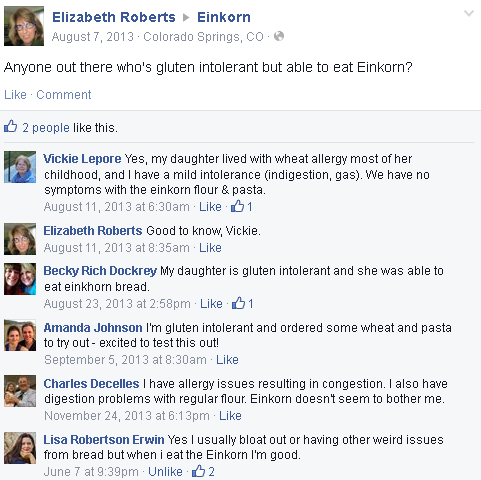 These people are experiencing that Einkorn is easier on their gut than other types of wheat but what could the reason? We know einkorn is incredibly nutritious, but what could make Einkorn easier to digest than other types of wheat?
I put my secondary research cap on to see if I could find out why…
First, I contacted a group that researches ancient grains.
You can watch their seminars on the history of wheat here. I asked them about the qualities that make Einkorn more digestible than other types of wheat, and this was the response from one of their nutritionists.
“The good concentration of several antioxidant compounds (carotenoids, tocols, conjugated polyphenols, alkylresorcinols and phytosterols) and low β-amylase and lipoxygenase activities (which limit antioxidant degradation during food processing) contribute to the excellent nutritional properties of [einkorn] flour, superior to those of other wheats. …It appears that the improved digestibility of einkorn is because of its starchstructure. Quality, texture and nutritional characteristics of flour and derived foods are influenced by starchstructure, content and composition. Because of the tightly packed starchstructure of einkorn, the amylose is more slowly digested than amylopectin, thus lowering glucose and insulin levels in the blood after meals and maintaining satiety longer.J Sci Food Agric 2014; 94: 601–612In a 2003 study, researchers at the Royal Veterinary and Agricultural University, in Frederiksberg, Denmark, compared three different loaves: einkorn bread made with honey-salt leavening; naturally-leavened einkorn bread made with crushed whole grains; and commercial yeast bread made with modern wheat. The naturally-leavened einkorn loaves significantly reduced the gastrointestinal response of GIP (glucose-dependent insulinotrophic polypeptide), a hormone important in controlling insulin secretion. European Journal of Clinical Nutrition, October 2003; 57(1):1254-61″ Mary W. Extension Nutrition Specialist
This response, along with many research articles I have read, gave me some answers to why Einkorn may be more digestible than other wheats. 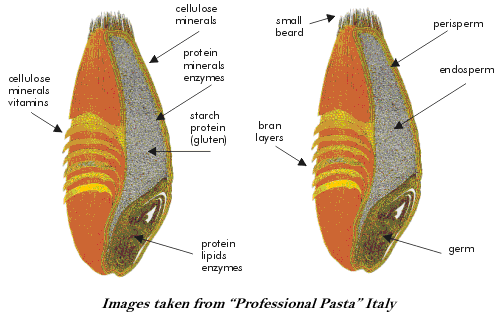
Reason #1 – The Unique Starchstructure of Einkorn
Einkorn’s starchstructure, (the composition of the different starches within the wheat grain) is not only much smaller than modern wheat but much more compact. Each type of wheat carries two different kinds of starches. Amylose and Amylopectin. Amylopectin is the faster releasing and digesting starch, which is amongst the culprits that quickly spike blood sugar. Amylose is the starch that releases slowly into the digestive system which in return is absorbed slower. Einkorn’s starchstructure is made up of much more of the slow digesting Amylose than Amylopectin. Einkorn’s unique design in it’s starchstructure assists in the, “lowering (of) glucose and insulin levels in the blood after meals and maintaining satiety longer” as is said in the first article above. But that’s not all. Einkorn also has less Amylose than other grains. Showing that overall, Einkorn has less of both of the starches that spike your blood sugar.
This study, shows that Einkorn has 10% less amylose than it’s closest cousin, Emmer and 20% less than Rye. It makes me wonder what it would be compared to modern wheat! In addition, the chromosomal count of Einkorn is a simple 14 compared to modern wheat of 42. As the chromosomes of modern wheat has increased, so has the modern wheat berry’s physical size. In ratio to that Amylose and Amylopectin has increased also. Modern wheat has been found to contain 75% Amylopectin.
Reason #2 – The Protein Composition Of Einkorn
The other reason that Einkorn is more digestible is because of it’s protein content. Over time wheat has been modified so much that it is estimated that 5% of proteins in wheat are new ones.
Modern wheat has been crossed with two different goat grasses over time. One of those goat grasses contained the D genome of gluten which has been the source of the most intolerance. Gluten is made up of two proteins found within different grains. Glutenin and Gliadin.
Along with changes to wheat, these proteins have been altered too. Example. Gliadin is the protein that causes most of the problems with allergies to wheat. Einkorn has a higher ratio of Gliadin to Glutenin, yet has been found in multiple studies to have a far less affect on those with allergies. According to this study, it probably has to do with the rich amino acid composition that lies within the Einkorn Proteins.
Remember Einkorn Contains the Original A genome of gluten, whereas Modern wheat also contains the D Genome of gluten, which has brought with it so many changes to the protein structure of wheat. You can tell when you work with Einkorn versus Modern Wheat that the gluten is quite different. The gluten in modern wheat allows for it’s elasticity and high rise. When I work with Einkorn the dough it is not as elastic and breaks down quicker. Which is why kneading for long periods of time is not necessary, it will begin to break down the proteins of the dough.
It needs to be noted however, that Einkorn contains gluten and has not been scientifically proven to be ok for those who suffer from celiacs disease, and that any one with gluten sensitivities should consult their Doctor before consuming Einkorn.
#3 Reason – More Soluble Proteins In Einkorn
One of the things you will notice when baking with Einkorn is that it doesn’t need as much water as when you are baking with modern wheat. This is because modern wheat absorbs more water than Einkorn, which assists in it’s higher rise.
The starch on the flour will absorb the liquid first, and then the proteins begin to absorb the water. Einkorn’s protein structure as stated above, has a higher ratio of the soluble to insoluble proteins. 2:1 in fact. Whereas, modern wheat and other varieties has a ratio of .8:1. Insoluble proteins are difficult for the body to digest. Einkorn’s 2:1 ratio in soluble protein to insoluble may lend to another reason of why it’s easier to digest.
Methods For Improving Digestibility
The nutritionist also noted a study which tested three kinds of breads, with three types of leavening. And mentioned that “The naturally-leavened einkorn loaves significantly reduced the gastrointestinal response of GIP (glucose-dependent insulinotrophic polypeptide), a hormone important in controlling insulin secretion.” Naturally leavened loaves were significantly lower in the gastrointestinal response of GIP than those made with commercial yeast, which has a direct affect on lowering the glycemic index of the bread! Natural leavening, sprouting wheat berries, and soaking them are three ways you can increase their digestibility. One of our Einkorn kitchens solely uses natural leavening in their breads, and we are excited to share more in future posts about the natural leavening process along with sprouting and soaking!
Image courtesy of David Castillo Dominici

44 thoughts on “3 Reasons Einkorn May Be Easier To Digest Than Other Types of Wheat”
Einkorn is low-medium in oxalates. 1/2 cup yields 7.92 oxalates per serving.
TMI warning! I was once so sick/apathetic/fatigued/etc that I spent my life in bed and having to use a wheelchair to attend church each week. Then I developed a case of colitis from 3 courses of antibiotics in rapid succession due to multiple infections. My first real memory in years is that night in the emergency department. I was told to begin a bland diet so I came home and lived exclusively on potato soup for the next several months. Almost overnight (it seemed) my brains and energy started to come back online and I started having the desire to get out of bed for the first time in years. The change was so drastic that I started researching what could possibly have caused it and I realized that my nursing background was completely devoid of any information on diet and nutrition beyond the most basic knowledge. As I learned more about nutrients (and anti nutrients) I stopped all refined flour and sugar, artificial sweeteners and vegetable oils and went almost exclusively organic. Over the next year I lost about 80 pounds and brought my a1c and blood sugar down to low normal levels from the “pre diabetic” levels my doctor was concerned about.
After not having any flour at all for several years I started adding small amounts of organic flour back into my diet and within a couple of years I was diagnosed with lymphocytic colitis. I was so sensitive to flour that even a small bite would cause a flare in this autoimmune condition.
Recently I have discovered that spelt doesn’t cause a reaction so this past weekend I got brave enough to try einkorn. I am excited to discover that it did not induce a flair either! I’m going to add soaking and fermentation to my processes to further reduce any potential problems but, since I didn’t see anyone commenting about this weird set of circumstances, I decided to add my story.
I’m curious about oxalates, my husband and I both have tested high, does sprouting , or making sourdough help lower them?
Hi Karen. Unfortunately, we haven’t been able to have it tested for that, so I don’t know about that. Sprouting and sourdough does make grain more digestible and increase the nutrient bioavailability, but I’m not familiar enough with oxalates to know if it helps with that.
where can i order the einlorn berries
Hi Margaret, they are trying to get the new facility up and running and are still a few weeks out. I’d be happy to let you know when it’s available again.
I am concerned with LECTINS. The typical wheats of today have a lot of lectins. Does Einkorn have lectins or less than other grains? Thanks, Charlie
Hi Charlie, we haven’t done that specific test on einkorn. If you are concerned about antinutrients like lectins, you may want to consider sourdough. Sourdough breaks down the lectins significantly.
I have been baking einkorn sourdough bread and apart from some gas am really loving it.
I have a question about oxalates in einkorn because I am very sensitive to this non food. Can anybody throw light on this question?
Hi Rachel, we haven’t ever researched that topic or done that specific test. Let us know what your search yields!
Does anyone know if this would apply to Einkorn?
> If using rye or wheat, first the grain must be mixed into water and then heated to create a wort.
> The heat breaks down the starches into fermentable sugars, which escape the grain
> and move into the water. Next, the wort is drained and the ensuing liquid becomes
> the ferment for vodka, also known as the wash.
http://www.probrewer.com/library/distilling/vodka/
> For enzymes to be able to break down starches, the starches must first be gelatinized.
https://www.wikihow.com/Make-Vodka
(This is relevant *not* “just” for vodka, but for fermentation in general; it’s IMHO the reason that secondary fermentation of conventional wheat or rye sourdough bread to Russian kvas works. I would like to run that additional fermentation in the levening phase of Einkorn sourdough, before baking, in order to lower the sugar/carbohydrate content of bread to as close to zero as possible. Any hints and experiences are greatly appreciated.)
Do you test at all for cross contamination with modern wheat? I don’t really know how you would do this but I have heard and fear a cross contamination with modern wheat. Are your fields far enough away from other wheat fields to prevent cross contamination?
Hi Sara, yes, we take steps to prevent cross contamination. We don’t ever follow modern wheat in our crop rotation and we make sure our machinery is used exclusively for einkorn for the same reason.
Wow, thank you.
A problem I frequently hear about is farmers having to rent their equipment; this way, contamination with glyphosate and foreign seed is pre-programmed. Good to know that you take precautions.
(Even so, I still buy only Einkorn berries, never the flour; call me paranoid. My husband won’t eat anything unless he can visually inspect it beforehand. Lucky us that Einkorn berries have this unique look. Both of us love Einkorn for its nutritional value and digestibility. It’s the Biblical wheat.)
please share wholesale supplier information.
thanks
Syeda, you can take a look at our wholesale information here.
I’m eating einkorn from more than a year now as a replacement of the common wheat. But I have a problem with gas everytime I eat more than one slice of einkorn bread. The reason is that it’s not digested into the stomach (as any type of wheat btw), but rather in the intestines, where it is eaten by bacteria, which is producing gas. This sucks because einkorn is the best from all the types of wheat out there and I’m avoiding others for obvious reasons. But in the past, I’ve eaten a whole bread of common wheat without any gas problems, which is odd considering how harmful many are describing it. So as much as I like einkorn, it’s still a grass and I still don’t want to eat it (or eat much) for that reason. I don’t know a solution to this gas issue.
Ivan, have you tried natural leavening? We have an upcoming article that discusses ways to prepare grains so that they’re easier on the digestive system. These processes, such as natural leavening, partially digest the grain so that our bodies don’t have to work so hard.
This is a very good advice. Natural levening (with wild yasts, NOT baker’s yeast) should pre-digest the carbohydrate and sugars. This way, the CO2 release that accompanies this kind of fermentation does not happen in the bowels but in a bowl, so to speak.
Other than that, I can relate, Ivan. Antibiotics have wrecked our guts. My problems went away as a result of eating only fermented food and drinking only fermented beverages for a couple of months, thinks like kombucha/jun, milk kefir, lacto-fermented vegetables, koji, natto, kvas, beet kvas, etc. When you find a way to replenish the microbiome in your gut, your symptoms should go away.
Agree completely…I stopped using commercial teary and switched to sourdough…the effect was almost immediate! No more gas or diarrhea.
I had terrible IBS-D for many years. It was a general life wrecker. I tried everything, yet nothing I did would stop the process. UNTIL…. I stopped eating all “modern wheat” products and started using Jovial Einkorn exclusively. Haven’t had an episode since, in over a year (knock on wood!). I can only conclude that “modern wheat” was killing my gut, and Jovial Einkorn helped to heal it. It feels a bit like a miracle to be feeling so well. So so so glad I found Einkorn.
I love Einkorn wheat, I use it for all my baking needs and don’t have any digestion problems from it. I also sell home baked breads and goods using this wheat. If you or anyone has any ideas on finding wholesale Einkorn wheat please email me. I talked with them at Jovial and the guy was down right rude to me about it saying they sell to whole sale to large facilities and when I asked how large would I have to buy he said “were not offering whole sale right now” Even though it’s on their website. It was hear breaking to have someone really put a damper on what I’m trying to do to help others learn the benefits of Einkorn wheat over modern. Maybe he was having a bad day but I sure wish I could find a line on some wholesale Einkorn wheat.
Hi Lisa, we offer a wholesale program. Please go to the contact us form to contact us about it.
Do you ship to Canada?
Hi George, we do. You can go here for our Canada order page.
I agree wholeheartedly. I love baking with Einkorn. In fact, it is the only flour I have been using for the last 3 yrs. It would be great to have the ability to purchase at wholesale prices. Will keep searching, I see it is becoming more available and the price has gone down in the last three yrs,though still a bit pricey.
The problems with wheat as it now is, is truly interesting and infuriating
at the same time, and if it is so damaging, why so much confusion.We continue to raise our kids on things that might in time hurt them.That is the way I see it.
It seems that many lo cost foods we eat, eaten to excess can harm us,like beans,garlic, onions, wheat,milk…and others.People are important!
> eaten to excess can harm us,like beans,garlic, onions, wheat,milk…and others.
Beans: never eat unless properly soaked (1-3 days for favas), cooked AND fermented (natto)
Garlic+onions: if you have trouble with these, your sulfation pathway is broken. My fix was: chelation on the Cutler protocol to get rid of the mercury in my system (in my severe case took about 10 yrs), and eating natto made with Bacillus subtilis (took 3 days to fix my intolerance of sulfur foods like garlic and onions)
Wheat: modern wheat is poison and full of poison (glyphosate is being used on it as a dessicant!!!! It’s criminal.) My fix: sourdough baked with einkorn OR 3 days long soaked einkorn eaten raw
Milk: Never ever drink pasteurized milk; the proteins are scrambled and become indigestible. You can try my fix: drink raw milk only OR restore nutritional value to organic store-bought milk using kefir grains. Try to get your hands on raw goat milk or sheep’s milk. There is a world of difference between these and cow’s.
Just made Shortbread Cookies with Einkorn Wheat and they are great. As I’m Gluten Intolerant, anything made with this flour does not cause digestive problems like Modern Wheat does. Thanks
I just came back from my first annual physical a year after getting off regular wheat and only eating einkorn. The results were staggering. My numbers have been constant for the last 5 years, but this year I saw:
a) a reduction in LDL from 131 to something so low that the machine couldn’t detect it
b) a reduction in fasting blood glucose from 105 to 86
c) a reduction in blood pressure of about 131 to 108
d) a reduction in triglycerides from 118 to under 45.
I credit my einkorn diet to this – it’s the only thing I’ve changed this year. I still eat plenty of salt, red meat and chocolate. In addition, I am less drowsy and bloated and generally more energetic.
Thank you for sharing your results, and congratulations on the progress you’ve since this past year!
I’m hoping for the same results as Monsanto and it’s modern Hybridized Wheat is poisoning us.
Thank you thank you for sharing this. I’ve recently had some blood work done and my nutritionist has recommended I go off all wheat. She must not know about ancient grains. I’ve found other research too on ancient grains that supports the results you got.
I used to make our bread most of the time, but buying bread was also ok. I had to stop eating it because it bothered me so badly. I was sad my husband and 5 sons chowed down on the fresh warm bread. I have told a few friends through the years that this wheat we have now adays (white wheat, the one in the 1980`s.. must not, can not be the same wheat spoken of in the Bible. Wheat is the staff of life NOT. So I am very excited to buy some and try making & eating those warm fresh loaves of bread. Then I will be able I think to say.. This must be what God spoke of in the bible.
Hi Joyce;
As a Pastor I have always believed in the bible and especially what it said about the food provided for us to feed the bodies He created. Yes, bread was one of the staples in the Bible, and I too was concerned that everyone was telling us that bread is bad for you. So the answer seemed to be in finding bread that was in the same form that God created it. Thankfully like you, I have discovered there is such a bread available today. Joyce, try applying this principle in all your foods – find it in the form in which it was created. Organic is a good start.
Do you know of any commercial breads that are made with Einkorn? Any that can be purchased in natural food stores or online?
I was diagnosed with celiac disease years ago I have ate gf for over 10 years I get very sick with modern wheat but I started baking with einkorn flour and gave up after many failed attempts of sourdough bread so a couple months later I started baking bread again with einkorn and i have had absolutely no problems I even feel better as thou I’m getting a surge of nutrion I believe in this einkorn flour and am so thankful to have found it please never change it I truely believe it’s the answer for anyone suffering with wheat or gluten intolerance
Thank you for sharing your amazing experience Christine. For those who read this, celiac disease patients should always consult their doctor before eating any food with gluten, including einkorn.
Christine, you said that the first time you had a failed attempt at Einkorn flour and sourdough. What did you do differently the second time you tried it?
I find this information you provide(d) on Einkorn to be quite fascinating. My wife does have a tremendous food allergy whenever she eats wheat products such as bread. Bloat, gas, etc….except her bloating symptoms a noticeably less when she consumes wheat products made in Europe. I recently purchased 5lbs. of Einkorn berries. Do you have any pasta recipes using this?In advance, my thanks, R. Meeker
Ralph, I’m happy to hear your wife is having some success with einkorn. You can check out the einkorn recipes here: https://www.einkorn.com/recipes/
HI MY WIFE HAS A BAD GLUTEN INTOLERANCE. I JUST MADE HER A POT OF DUMPLINGS WITH EINKORN FLOUR. AFTER EATING A GOOD SIZE PORTION OF THE DUMPLINGS WITH SAUCE SHE HAD ZERO PROBLEMS. AWESOME!!!!! JUST PLAIN AWESOME. PANCAKES FOR BREAKFAST… ONE OF HER FAVORITES. I STARTED RESEARCHING THIS AFTER SHE ATE BREAD IN AFRICA ON A MISSION TRIP AND HAD NO REACTIONS. OLD SCHOOL HERITAGE GRAINS IS THE KEY. THANKS SO MUCH
Bread made in Europe often has a much longer proving period which breaks down the gluten. Commercially produced breads are proved in around 2 hours whereas European breads are proven at around 24 hours. 😉
Ralph, you should try doing Sour Dough with your Einkorn. The Sour Dough makes the Gluten even more digestible. I am sensitive to gluten but real sour dough breads hardly bother me so I bet using the Einkorn as a sour dough should do the trick.