
For over 7,000 years, mankind has cultivated and developed wheat for breads and cereals. Today, we consume more wheat, as a percentage of our daily diet, than any other food. Just think about that and the effects wheat can have on our health – good or bad!

Wheat Bread, just one of the many ways we like to eat different types of wheat
I’ve been researching the nutritional content of 19 different types of wheat, and I’ve included a link to all of my findings in this post. This post focuses on the nutritional content and health benefits of einkorn wheat compared with the common types of wheat of which most of our food from the grocery store is made.
In doing my research, it is easy to see why there has been renewed worldwide interest in ancient einkorn. The interest comes not only from einkorn’s unique gluten structure but also it’s incredible nutritional qualities.
Here are some interesting facts I learned about the nutritional content and health benefits of einkorn:
- Wheat gluten studies have found einkorn may be non-toxic to suffers of gluten intolerance
- Einkorn wheat has 14 chromosomes while modern wheats have 42 (Friendly to the body’s digestive system)
- Einkorn contains 3 to 4 times more beta-carotene than modern wheats (Boosts immunity, helps prevent cancer and heart disease)
- Einkorn contains 2 times more Vitamin A (retinol equivalent) than modern wheats (Healthy eyes, reproductive organs and prevention of many cancers)
- Einkorn contains 3 to 4 times more lutein than modern wheats (Prevention of macular degeneration and cataracts)
- Einkorn contains 4-5 times more riboflavin than modern wheats (Used by the body to create energy and is an antioxidant that slows aging)
- Einkorn is a “hulled” wheat, whereas modern wheats are not. The hull can protect the grain from stray chemical contamination and insects making it an easier grain to grow ORGANICALLY!
Einkorn vs Major Types of Wheat Comparison Matrix
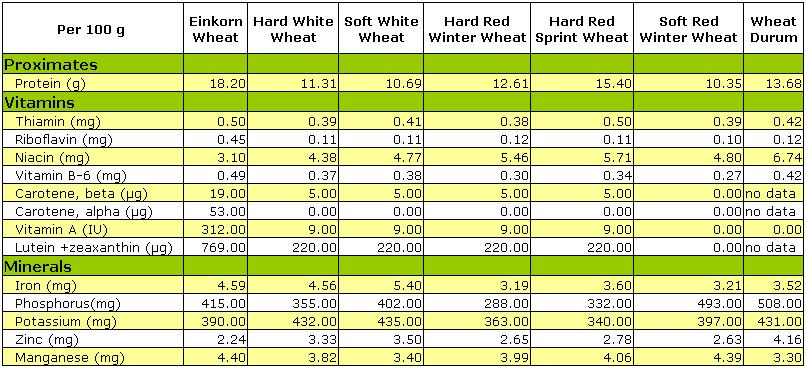
Brief Comparison of Einkorn and Major Types of Wheat
See my full nutritional matrix comparing 19 types of wheat (pdf), including einkorn. This matrix also includes my sources and references.
I didn’t realize einkorn was so nutritious (compared to the other types of wheat). Thanks for sharing this information.
The most beneficial aspect is the fiber content of ancient wheats. In the ancient world much of the wheat was ground with the husk increasing the fiber content considerably. So although humans are not designed to eat wheat, cooking it reduces the toxin levels to tolerable ranges and the extra fiber moved it through the system quickly.
Today’s ultra refined, naked whats amount to rocket fuel. This is not only a fuel we did not evolve to eat, modern wheat offers too little fiber to move it through the system quickly.
Speaking of rocket fuel… Whenever I eat a bowl of cold cereal, like rice Chex or something similar, I get a serious sugar crash about 3 hours later. I get jittery and have a hard time thinking straight. This doesn’t happen when I eat whole-grain stuff that I make myself. I’m guessing it’s the amount of sugar and carbs combined.
Your blood sugar rises dramatically and along with it so do your insullin levels. When the sugar crash happens your insullin has done a remarkable job… too well indeed and has brought your sugar levels too low. What happens next is the body wants more carbs. This causes a roller coaster ride of spiking sugar and insullin levels through out the day.
If anything the fiber in ancient wheat is lower than modern wheat which I actually prefer anyways.
Great. Thank-you. Where can one find this in stores? What brands etc.
Pingback: Einkorn Is The Best Compared To The Trendy Wheat HYIP Space: News, Monitoring and Articles
What is the long-term storage life for Elkhorn wheat? Hard red winter wheat and hard white wheat are each 30 years. How does Elkhorn compare?
Pingback: Whole Grains & Soaking « Nourishing My Life
Pingback: Triticum Monococcum » Einkorn.com
In your detailed PDF chart it shows Durum Wheat has nearly all Vitamins and Minerals in larger quantity then Einkorn. Can you please shed some light on that.
Durum wheat has less of almost everything except phosphorus, potassium and zinc, all the others it is significantly less, but Durum wheat is also dwarf wheat that is inflammatory, causes weight gain, and addictive. It’s literally designer wheat with the emphasis on craving more. Organic Einkorn and Emmer wheat is ancient wheat and if we’re going to eat a grain that isn’t something we should be eating anyway, it is best to eat Einkorn or Emmer, at least that’s what the science says. Personally, I know only what I read but I do observe the effect wheat has on world health, and that means we don’t need any research team to be funded, the proof is everywhere Western diet goes, soon doctors and dentists follow. What a scam steeped in stupidity or psychopathy or insanity, maybe all three. What kind of people would first create stuff they don’t need, to get them to buy what they don’t need, that necessitates the need to work their butts off to pay for said stuff they don’t need, then feed them stuff that makes them sick, ugly, fat and dead. And that isn’t just a little crazy, that’s insanity on a large scale.
What does it take to grow Einkorn? If I ordered the berries, could I grow it? What kind of climate does it like, etc.?
Erin, it likes cool, dry climates
Since sugars in the Einkorn is higher than other grains listed how does that effect the glycemic index in the blood stream? What part of the grain stores these sugars?
Thank you,
Brenda
Brenda, On this topic, Dr. William Davis shared the experience a friend of his had with einkorn:
Pingback: Ancient Grains: Einkorn Pilaf with Lemon | dishes and dishes
Pingback: What's With All the Different Kinds of Wheat? | Quick and Easy Cheap and Healthy
Pingback: Einkorn Flour
Pingback: Einkorn Tortillas, A Delicious Wrap » Einkorn.com
I’d like to know the carbohydrate count. The advanced chart says “no data” in that column. Why do we know the fiber and sugars but not the carb count?
Pingback: Finkelstein Einkorn- Did you know? | Sharing is caring.
cool
Why does the increased number of chromosomes make modern wheats harder to digest?
Introduction of the D genome in hexaploid and tetraploid wheats is possibly the reason. Detection of an unacceptable level of the D genome, is the basis for detection of gluten in gluten-free facilities. Einkorn does not contain the D genome
Pingback: 3 Reasons Einkorn May Be Easier To Digest Than Other Types of Wheat » Einkorn.com
THANKS ADMIN ,
I WAS NOT ABLE TO COMPLETE MY PROJECT . AND I OPEN THIS SITE, IT REALLY HELPED. I AM THANKFUL TO U FOR THIS INFORMATIVE
COMPOSITION . AGAIN A LARGE THANKS TO U .
Wish you would include that Einkorn has a higher protein to carbohydrate ratio (28% vs 10%) compared to dwarf wheat species. This is the critical reason why blood sugar results in high insulin, the cause of a vast number of diseases of civilization…heart disease, diabetes, cancer, obesity to name a few.
can you tell me pleas what is the expected protein level in einkorn and how dose it compare to spelt? also how dose it yeald per acer?
will
Will, einkorn contains about 18.2 grams of protien per 100g, and spelt contains about 14.57. The yield for Einkorn gets tricky because it is hulled. That contributes to a lower net clean-out rate. So the net yield is quite a bit lower than spelt’s.
Questions, how long does it takes to clean your system from white flour
And is wheat bread better for your body. Thanks for informative info
Hi Cynthia, I don’t know how long it takes to clean white flour from your body. That would be interesting to research. Whole grain bread is always going to be better for you than white bread. Whole grain has the bran and the germ which is where the bulk of the nutrients are. Those things have been removed from white flour. Einkorn, which is more nutrient dense and healthier than modern wheat, will make even more nutritious bread.
Wonderful! I will try adding Einkorn to soured rye bread. BTW, it is worth noting that their are substantial anti nutrients in all grains including Einkorn and fermenting the dough with wild yeast is a great way to remove them, while enhancing nutrition. Also, all flours begin rancidification as soon as they are ground, so I grind mine as I need it.
Cheers for the information bro!
I very much appreciate the PDF. Thank you!
Made a loaf of einkorn bread today using dried yeast without added fat. It did not seem to oven proof when baked. Wondering why? Would like to try a simple fermented wild yeast recipe.
Hi Charlene, there is definitely a learning curve with einkorn. One thing I would suggest is making sure not to over flour it. We’ve found that a very wet dough rises much better (more wet than normal bread dough). When I’m making yeast einkorn bread, I don’t even knead mine with my hands because it’s too wet and sticky of a dough. So I use the dough hook on my bosch, and I use a spatula to get it into the loaf pans and I smooth it in the loaf pans with the spatula. It rises very well. That’s not the only way to do it, but the point is the dough works better if it’s wetter. Einkorn tends to be sticky and so people make the mistake of overflouring to get it not to be. It’s best to find another way to deal with the stickiness. Without being in your kitchen, it’s hard to know what else might help but hopefully that gives you an idea.
I have been baking equal amounts of einkorn, & wholemeal spelt with added linseed, pumpkin seeds, chia & sunflower seeds plus some unground pumpkin seeds. Everyone who tried my bread loves it but so far no one has switched to baking their own. After reading the above I think I’ll try just einkorn. I currently have a sourdough starter of the above three flours on the go. My previous attempts at sourdough using simple wholemeal flour tasted too sour for my taste. I see that my local Aldis supermarket is,stocking sourdough but it looks as if its made with white flour.
Hi Kenneth, any sourdough starter will work fine. You just start feeding it with einkorn flour and it becomes an einkorn sourdough starter.
Your full comparison doesn’t have buckwheat. I would be very curious to see that.
Hi Dickens, it’s not part of that table. But here is a link to some buckewhat specifics. You can draw your own comparisons from that.
Does einkorn baked items taste like modern wheat baked items?
Hi Brian, the taste is comparable, but einkorn does have its own great flavor. Some describe it as nutty. It is a delicious flavor but not overpowering.
Does anyone have a good recipe for bread using Einkhorn?
I have avoided wheat for years, as the next day after eating it I suffer greatly with headache, joint pain, brain fog and it’s just not worth it. But I sure miss bread! Also, the ONLY health warning that showed up on my 23&Me DNA health report was a tendency to macular degeneration, which frightened me because I’m an artist. It appears Einkhorn wheat could be helpful I’m hoping if I can find a recipe that works.
Here are some of our recipes:
Einkorn Italian Sandwich Bread
Basic White Einkorn Yeast Bread
Naturally Leavened (Sourdough) Einkorn Bread
Einkorn French Bread
I also like this one, but I triple the salt:
I would be interested to know the omega 3 and Omega 6 content of Einkorn.
Hello, unfortunately we do not have the data on that, but it’s a great question. Hopefully more research is done on the topic.
I would like to know the individual amino acid percentages as I am enjoying exploring whole protein recipes with different things (like almond flour and others). I can’t seem to find this information. The total amount of protein is not helpful for my purposes. Can anyone help, please?
Hi Peggy, we haven’t had that specific test done. Einkorn was fairly recently rediscovered and doesn’t have the body of research that other more common grains do yet. Hopefully more studies are done on it.