
Einkorn Nutrition Facts
Calories, protein, vitamins, minerals, gluten profile, and the per-100 g numbers — sourced from USDA FoodData Central and peer-reviewed research.

Explore Einkorn Nutrition
- What makes einkorn different?
- Einkorn may be gentler on blood sugar (especially as sourdough)
- Einkorn packs more protein than typical modern wheat
- Einkorn delivers more zinc, lutein, and key minerals than modern wheat
- Why do so many people tolerate einkorn, even when modern wheat bothers them?
- Einkorn vs. modern wheat: the head-to-head
- Glyphosate desiccation: a US-specific problem most eaters don't know about
- Berries, flour, and bread: how einkorn nutrition shifts by form
- The 5 biggest reasons people switch to einkorn
- Einkorn Wheat Frequently Asked Questions
- Satisfaction Guarantee
- References
The wheat we eat today isn’t like they ate thousands of years ago. In nutrition sampling tests, einkorn has been found to be a more nutritious grain. Einkorn contains higher levels of protein, essential fatty acids, phosphorus, potassium, pyridoxine (B6), lutein, and beta-carotene.
There’s a reason people ate this stuff for thousands of years and called it “the staff of life.” Einkorn has been feeding people for thousands of years, but its age is not the first thing most bakers notice.
They notice the warm golden color. The lightly nutty flavor. The soft dough that feels different from ordinary wheat dough.
This guide explains what is actually in einkorn, how it compares with common wheat, and what those differences mean in your kitchen.
Einkorn is the original cultivated wheat — the variety humans were eating before modern breeding rewired the genome. It was cultivated thousands of years before the wheat varieties commonly used for bread today.
It’s also known as farro piccolo, kleinspelt, and littlespelt. Not to be confused with spelt.
Einkorn is a nutrient-packed grain: per 100 g of whole grain, einkorn delivers 369 kcal, 15.1 g of protein, 3.81 g of fat, 68.7 g of carbohydrate, 8.9 g of dietary fiber, and standout amounts of zinc, manganese, phosphorus, and the carotenoid lutein (USDA FoodData Central; Ziegler et al., 2015).

What makes einkorn different?
Einkorn (pronounced EYE-n-korn, from the German for single grain) is different from the typical wheats, breads, and flours you’ll see in your grocery aisle.
The oldest cultivated wheat on earth, first domesticated about 10,000 BCE in southeastern Anatolia, einkorn is also the simplest. Einkorn carries seven pairs of chromosomes — 14 in total. Modern bread wheat carries 21 pairs and 42 total chromosomes.
Why does modern wheat have so many more chromosomes? This is the result of hybridization, plus over a century of intensive breeding. Historically, farmers bred wheat for higher yield, shorter stalks, and easier industrial milling. While this has made modern farming easier, it also dramatically altered the structure of the wheat itself, introducing new problems.
Einkorn never underwent this change. Its proteins, starch, and mineral profile are the originals. These differences become easier to understand when looking at the grain itself:
Einkorn nutrition facts (per 100 g)
Nutrition values can vary with the einkorn variety, soil, weather, storage, and milling process. Flour and finished foods will also differ from the whole dry grain.
For the most accurate information about a particular flour, pasta, or bread, check that product’s nutrition label. You can find einkorn.com nutrition labels here.

Values are drawn from the USDA FoodData Central entry for einkorn whole grain (USDA FDC 2710827, published 2024). Einkorn is available as whole grain berries, whole-grain flour, and all-purpose flour.
¹ USDA FDC 2710827 (Foundation Foods, 2024-10-31). ² Whole-grain einkorn flour values estimated from the USDA whole-wheat flour comparator (FDC 790085) and Hidalgo & Brandolini (2014) — see all-purpose einkorn flour. ³ Bread values modeled at 75% hydration with whole einkorn berries milled fresh; actual values vary with hydration and formula.
Einkorn may be gentler on blood sugar (especially as sourdough)

Glycemic-index research on pure einkorn bread is still a bit limited — but the story so far is encouraging for anyone watching their blood sugar. A 2024 study reported in-vitro GI values of 89–94 for a Turkish dried bread enriched with einkorn flour. In a pig-model trial, einkorn bread produced a clearly lower postprandial insulin response than equivalent bread made from modern wheat. How einkorn is processed appears to be clearly different. However it’s worth noting that there are other big factors in blood sugar responsee: refined vs. whole-grain, fast-leavened vs. slow sourdough — all of this changes the blood-sugar response, in addition to the grain itself.
Is einkorn good for diabetics?
Animal and in-vitro evidence suggests einkorn bread, especially as long-fermented sourdough, produces a gentler glycemic and insulinemic response than modern-wheat bread. It isn’t a clinical claim — anyone managing diabetes should treat einkorn as a whole-grain wheat in their carbohydrate budget and work with a registered dietitian or their primary care physician to make individualized health choices.

Einkorn packs more protein than typical modern wheat
Einkorn whole grain contains about 15.1 g of protein per 100 g (USDA FDC 2710827). Across cultivars, wholemeal einkorn protein runs anywhere from 15% to 22% of dry matter (Hidalgo & Brandolini, 2014). Typical modern bread wheat sits at 10–14% — meaning einkorn routinely brings 20–40% more protein per bite than the wheat in a typical grocery loaf. The dramatic difference shows up against refined white wheat; the gap is smaller against USDA whole-wheat flour, which also lands near 15 g per 100 g.
The protein isn’t just more. It’s built differently. Einkorn’s gluten-forming proteins are simpler and shorter than modern wheat’s — including the absence of one specific fragment (the “33-mer,” covered in the gluten section below) that’s a leading suspect in the wheat-tolerance issues many modern eaters report.
For bakers, einkorn dough behaves differently in the bowl: stickier, looser, and slower to rise than high-gluten modern flour. The bread comes out denser and more tender, with a tighter crumb and a deeper color. For the specifics of adjusting your baking to work with this unique grain, see our tips for baking with einkorn flour.
A note for fairness: einkorn is one of the highest-protein wheat species, but it isn’t the highest-protein grain. Oats, hemp, quinoa, and amaranth equal or exceed it.
Einkorn delivers more zinc, lutein, and key minerals than modern wheat
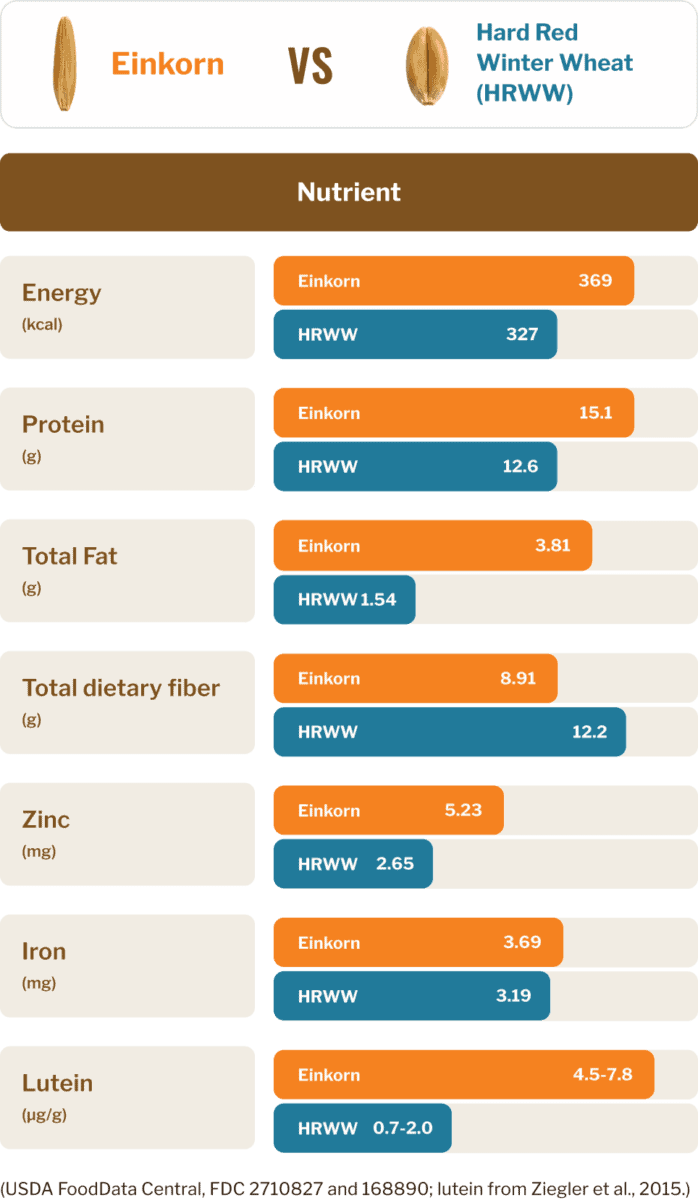
The biggest mineral gap is zinc. The USDA puts einkorn at 5.23 mg per 100 g versus 2.65 mg for hard red winter wheat — close to twice as much. A 100 g serving covers roughly half the daily zinc needs of an adult woman (8 mg/day) and a third for a man (11 mg/day). Phosphorus runs 436 mg per 100 g — about 62% of the 700 mg daily target — versus 288 mg in modern wheat (Zhao et al., 2009). Manganese at 4.20 mg already exceeds the daily adequate intake for both men (2.3 mg) and women (1.8 mg). Iron is modestly higher (3.69 mg vs. 3.19 mg).
One caveat: all whole grains contain phytic acid, which binds minerals like zinc and iron and reduces absorption. Sourdough fermentation — the long, slow rise traditional einkorn bread uses — breaks down phytic acid and boosts how much of those minerals you actually absorb. Form matters.
The B-vitamin profile is broadly comparable to whole-wheat flour — thiamin, niacin, and B₆ all land in the same range.
Where einkorn pulls away is the carotenoids — the plant pigments that make egg yolks yellow and carrots orange. The headline carotenoid here is lutein, the pigment most studied for protecting the macula of the eye as people age. Ziegler et al. (2015) measured einkorn lutein at 4.5–7.8 µg per gram of dry matter — roughly 0.45–0.78 mg per 100 g of grain, or about 200–310 µg in a single 40 g slice of einkorn bread. Bread wheat lands at 0.07–0.20 mg per 100 g — three to seven times less. Hidalgo and Brandolini (2008) found a similar gap for total carotenoids. These are the pigments behind einkorn flour’s butter-yellow color, and they’re a real nutritional differentiator.
For the longer-form benefits roundup, see the dedicated page.
Why do so many people tolerate einkorn, even when modern wheat bothers them?
Modern wheat has changed, and a lot of people don’t feel great after eating it.
Today’s bread wheat is a hexaploid hybrid — six complete sets of chromosomes (forty-two total). Einkorn has two sets (fourteen total). Modern wheat got bigger and easier to mass-produce, but its gluten got more complex along the way. One particular fragment of modern wheat’s gluten — the “33-mer” — is the single best-studied trigger of the celiac immune response, and a leading suspect in the broader “I don’t tolerate wheat well” experience.
A 2017 mass-spectrometry study found the 33-mer at 91–603 µg/g in 38 modern and 15 historical hexaploid wheats and 2 spelt cultivars — but below the limit of detection in einkorn. A 2020 ex vivo digestion study reinforced the result: einkorn released 38 distinct immune-triggering peptides versus 72–155 for common bread wheats; the 33-mer and two other major triggers weren’t detected at all in einkorn digests (Bjorkøy et al., 2020).
So when someone says: “I can eat einkorn bread when I can’t eat normal bread” – the science appears to back their anecdotal experience up. See also three reasons einkorn may be easier to digest and research on the lower in-vitro toxicity of einkorn gliadin (Vincentini et al., 2007) for more detail on this.
One thing einkorn is not, however, is gluten-free. It contains gluten and is detected by the standard R5 ELISA used in the FDA and Codex gluten-testing methods. It does not meet the 20-ppm gluten-free threshold under FDA 21 CFR 101.91 or Codex CXS 118-1979. For people with celiac disease, talk with your doctor to understand whether einkorn may or may not work for you. See is einkorn flour gluten-free? for more information.
Einkorn vs. modern wheat: the head-to-head
Side-by-side per 100 g of whole grain:
Einkorn isn’t simply more nutritious: more protein, more healthy fats, more zinc, more phosphorus, and dramatically more carotenoids than modern flours and even hard red winter wheat. It’s slightly lower in total dietary fiber than hard red — if total fiber is what you’re optimizing for, whole-wheat or rye supplies more. For the full side-by-side of einkorn, spelt, emmer, kamut, and modern bread wheat, see our comparison page.
The bigger story is what hasn’t been done to einkorn. Modern bread wheat is the product of two ancient grass crossings, plus over a century of intensive breeding for higher yield and shorter plants. In fact, the hybridization history that produced today’s gluten structure is believed to be the cause of the rise in gluten intolerance.
Glyphosate desiccation: a US-specific problem most eaters don't know about
A meaningful portion of US conventional bread-wheat acreage is treated with pre-harvest glyphosate — sprayed onto the standing crop in the days before harvest to kill it to a uniform moisture and speed up combining. Residues of glyphosate and its metabolite AMPA have been measured in conventional wheat-based foods sold in US grocery stores. The practice is legal and residue levels sit below the EPA’s tolerance, but a growing share of shoppers prefer to avoid these residues regardless.
Einkorn is produced almost entirely by small organic and regenerative growers and isn’t managed this way. It’s part of the reason einkorn customers say their food just feels different. All of einkorn.com’s einkorn products are certified organic and glyphosate-free.
Berries, flour, and bread: how einkorn nutrition shifts by form
Whole einkorn berries deliver the full nutrient profile (see the table above.) They cook in 30–40 minutes and work beautifully as a side grain or salad base.
Whole-grain einkorn flour keeps the bran and germ — and most of the per-100 g mineral and carotenoid load — while behaving differently from modern wheat flour: its particle size is smaller and ash content (1.5–2.0%) is higher than typical bread wheat, which changes how it absorbs water and rises.
As a bread, a typical 40 g slice of 80% einkorn sourdough bread contains roughly 18–22 g of carbohydrate, at a lower glycemic index than modern breads, depending on the loaf’s hydration and einkorn-flour ratio. Per-100 g values are also in the table above. For a step-by-step einkorn bread baking guide using whole-grain einkorn flour, see the bread-baking post.
The 5 biggest reasons people switch to einkorn
- More protein than typical modern wheat. 15–22% of dry matter (USDA; Hidalgo & Brandolini, 2014) — among the highest of cultivated wheats.
- Roughly twice the zinc and 50% more phosphorus than hard red winter wheat, per 100 g (USDA) — meaningful percentages of a day’s needs in a single serving.
- Three to seven times the lutein of bread wheat (Ziegler et al., 2015) — the same antioxidant pigment most studied for eye health, and the reason einkorn flour is yellow.
- None of the 33-mer α-gliadin fragment that’s the single best-studied trigger of the celiac immune response (Schalk et al., 2017). Einkorn still contains gluten and is not safe for celiac, but it skips the most-studied wheat-tolerance trigger.
- Lower postprandial insulin response in pig-model trials versus modern-wheat bread (Barone et al., 2018) — early evidence that einkorn may be gentler on blood sugar, especially as sourdough.
For our longer-form benefits roundup, see the dedicated page.
EINKORN WHEAT
FREQUENTLY ASKED QUESTIONS
Is einkorn gluten-free?
No. Einkorn contains gluten and is detected by the standard R5 ELISA used in FDA and Codex methods. It does not meet the 20 ppm gluten-free threshold under FDA 21 CFR 101.91 or Codex CXS 118-1979 and is not safe for people with celiac disease.
Is einkorn healthier than modern wheat?
Selectively. Per 100 g, einkorn carries more protein, more zinc and phosphorus, and three to seven times the lutein of typical bread wheat. It is lower in total dietary fiber than hard red winter wheat. “Healthier” depends on what you’re optimizing for.
What is the glycemic index of einkorn?
A single defensible GI value for pure einkorn isn’t established in the literature. In-vitro studies of einkorn-enriched breads have reported GI in the high range; pig-model work shows a lower postprandial insulin response than modern wheat. Sourdough leavening and processing change the response significantly.
How much protein is in einkorn?
About 15.1 g per 100 g of whole grain (USDA FDC 2710827); 15–22% of dry matter across cultivars (Hidalgo & Brandolini, 2014).
Can people with gluten sensitivity eat einkorn?
Many people with non-celiac gluten or wheat sensitivity report tolerating einkorn better than modern wheat — consistent with einkorn’s lack of the 33-mer α-gliadin fragment. That’s a real signal, not a guarantee. Einkorn still contains gluten and should not be eaten by people with celiac disease.
Is einkorn an ancient grain?
Yes. Einkorn was first domesticated around 10,000 BCE in southeastern Anatolia (Heun et al., 1997), making it the oldest cultivated wheat and one of the founding crops of Neolithic agriculture.
Satisfaction Guarantee
We stand behind everything we make and ship. Every bag of einkorn flour, every batch of grain, and every baking mix is prepared with care and tested for quality before it leaves our mill. If something doesn’t meet your expectations, we’ll make it right.

Our goal is simple: we want you to feel confident every time you order from us. Whether you’re trying einkorn for the first time or restocking your pantry, you deserve a product that feels fresh and performs beautifully in your kitchen.
Your trust means everything to us. If you’re not completely satisfied with your purchase, please reach out to our team within 30 days, and we’ll be happy to replace or refund your order. Freshness, flavor, and satisfaction are always part of the promise.
References
Primary nutrient databases
- U.S. Department of Agriculture, Agricultural Research Service. (2024). FoodData Central: Einkorn, grain, dry, raw. FDC ID 2710827. https://fdc.nal.usda.gov/food-details/2710827/nutrients
- U.S. Department of Agriculture, Agricultural Research Service. (2019). FoodData Central: Flour, whole wheat, unenriched. FDC ID 790085. https://fdc.nal.usda.gov/food-details/790085/nutrients
- U.S. Department of Agriculture, Agricultural Research Service. (2019). FoodData Central: Wheat, hard red winter. FDC ID 168890. https://fdc.nal.usda.gov/food-details/168890/nutrients
Peer-reviewed studies
- Barone, F., Laghi, L., Gianotti, A., Ventrella, D., Saa, D. L. T., Bordoni, A., Forni, M., Brigidi, P., Bacci, M. L., & Turroni, S. (2018). In vivo effects of einkorn wheat (Triticum monococcum) bread on the intestinal microbiota, metabolome, and on the glycemic and insulinemic response in the pig model. Nutrients, 11(1), 16. https://doi.org/10.3390/nu11010016
- Bjorkøy, L. E., Lundin, K. E. A., Hovland, A., et al. (2020). Ancestral wheat types release fewer celiac disease related T cell epitopes than common wheat upon ex vivo human gastrointestinal digestion. Nutrients, 12(9), 2588. https://doi.org/10.3390/nu12092588
- Cao, L., Pu, J., Scott, R. P., Ching, J., & Eitzer, B. D. (2016). Glyphosate and AMPA residues in conventional and organic wheat-based foods sold in the United States. Journal of Agricultural and Food Chemistry, 64(20), 4047–4053. https://doi.org/10.1021/acs.jafc.6b00919
- Heun, M., Schäfer-Pregl, R., Klawan, D., Castagna, R., Accerbi, M., Borghi, B., & Salamini, F. (1997). Site of einkorn wheat domestication identified by DNA fingerprinting. Science, 278(5341), 1312–1314. https://doi.org/10.1126/science.278.5341.1312
- Hidalgo, A., & Brandolini, A. (2008). Kinetics of carotenoids degradation during the storage of einkorn (Triticum monococcum L. ssp. monococcum) and bread wheat (Triticum aestivum L. ssp. aestivum) flours. Journal of Agricultural and Food Chemistry, 56(23), 11300–11305. https://doi.org/10.1021/jf802448t
- Hidalgo, A., & Brandolini, A. (2014). Nutritional properties of einkorn wheat (Triticum monococcum L.). Journal of the Science of Food and Agriculture, 94(4), 601–612. https://doi.org/10.1002/jsfa.6382
- Schalk, K., Lang, C., Wieser, H., Koehler, P., & Scherf, K. A. (2017). Quantitation of the immunodominant 33-mer peptide from α-gliadin in wheat flours by liquid chromatography tandem mass spectrometry. Scientific Reports, 7, 45092. https://doi.org/10.1038/srep45092
- Shewry, P. R. (2009). Wheat. Journal of Experimental Botany, 60(6), 1537–1553. https://doi.org/10.1093/jxb/erp058
- Vincentini, O., Maialetti, F., Gazza, L., Silano, M., Dessì, M., De Vincenzi, M., & Pogna, N. E. (2007). Environmental factors of celiac disease: cytotoxicity of hulled wheat species Triticum monococcum, T. turgidum ssp. dicoccum and T. aestivum ssp. spelta. Clinical Nutrition, 26(3), 361–369. https://doi.org/10.1016/j.clnu.2007.02.003
- Yuksel, F., & Çağlar, S. (2024). In vitro glycemic index, acrylamide content, and some physicochemical and sensorial properties of special dried bread (peksimet) enriched with einkorn wheat (Triticum monococcum L.) flour. Journal of Food Science and Technology, 62(2), 368–376. https://doi.org/10.1007/s13197-024-06035-8
- Zhao, F. J., Su, Y. H., Dunham, S. J., Rakszegi, M., Bedo, Z., McGrath, S. P., & Shewry, P. R. (2009). Variation in mineral micronutrient concentrations in grain of wheat lines of diverse origin. Journal of Cereal Science, 49(2), 290–295. https://doi.org/10.1016/j.jcs.2008.11.007
- Ziegler, J. U., Wahl, S., Würschum, T., Longin, C. F. H., Carle, R., & Schweiggert, R. M. (2015). Lutein and lutein esters in whole grain flours made from 75 genotypes of 5 Triticum species grown at multiple sites. Journal of Agricultural and Food Chemistry, 63(20), 5061–5071. https://doi.org/10.1021/acs.jafc.5b01477
Regulatory and standards bodies
- Codex Alimentarius Commission. (1979, revised 2008). Standard for foods for special dietary use for persons intolerant to gluten. CXS 118-1979. https://www.fao.org/fao-who-codexalimentarius/codex-texts/list-standards/en/
- Codex Alimentarius Commission. (1999, revised 2017). Standard for the labelling of and claims for foods for special dietary uses. CXS 234-1999. https://www.fao.org/fao-who-codexalimentarius/codex-texts/list-standards/en/
- U.S. Food and Drug Administration. (2013). Gluten-free labeling of foods; final rule. 21 CFR 101.91. https://www.fda.gov/food/nutrition-food-labeling-and-critical-foods/gluten-free-labeling-foods
- U.S. Department of Agriculture, National Agricultural Statistics Service. (2024). Agricultural Chemical Use Survey: Wheat. https://www.nass.usda.gov/Surveys/Guide_to_NASS_Surveys/Chemical_Use/