
Let’s continue our discussion about methods for making healthy bread by talking about how to make your own sourdough start. A handy thing to know if you want to make your own healthy einkorn bread.
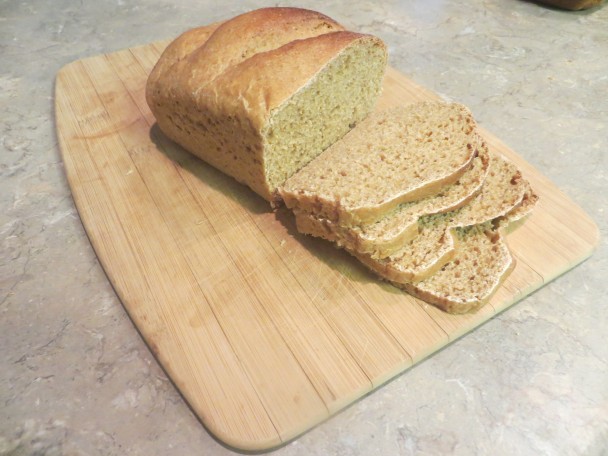
As you may know, sourdough bread rises without the use of packaged yeast. The bread dough undergoes a fermentation that causes it to rise.
But about how does one get a sourdough start to begin with?
You can either get one from someone you know or make one yourself. Even if you are making einkorn sourdough bread, you can get a small sourdough start from a friend – it does not have to be einkorn – and use that to begin your einkorn sourdough start by simply feeding it einkorn flour.
But today, I want to share how to create your own sourdough or natural leavening start.
The make-it-yourself process was something new for me. We got ours from a friend. However, so many people were asking about it that I decided to try it. I adapted Dr. Price’s sourdough method for Einkorn.
This took a couple of tries. The first couple of attempts just didn’t work at all. I was tempted to tell everyone to figure it out themselves. I watched some less-than-helpful youtube tutorials with complex recipes and procedures that just didn’t work for me. Then I found Dr. Price’s recommendation. I didn’t follow it exactly but it helped give me an idea.
Even using his method, the first couple attempts were failures. My guess is that the temperature was not right. It should be about 60°-65°. I got it to work placing it in the oven with the light off. Another mistake I made was covering it too tightly. I just used the lid that goes with the bowl, but that stifled the growth. In this case, I used Dr. Price’s recommendation – covering it with parchment and a damp towel.
The start that finally ended up working is pictured below. It smelled really horrible for the first few days, and I contemplated throwing it away because it did not smell like sourdough to me. However, after a few days it began to smell like sourdough and worked successfully in a recipe. So, don’t despair. It does take a few days to complete.
Day 1: Measure 120 grams of Einkorn flour and 120 grams of lukewarm tap water into a glass bowl. The mixture should be thick and pasty. Loosely cover (I took Dr. Price’s advice and covered it with parchment and a damp towel) and place in oven with the light off (The temperature is important. I found that, for where I live, that was the best place to keep the temperature right. You may need to experiment).
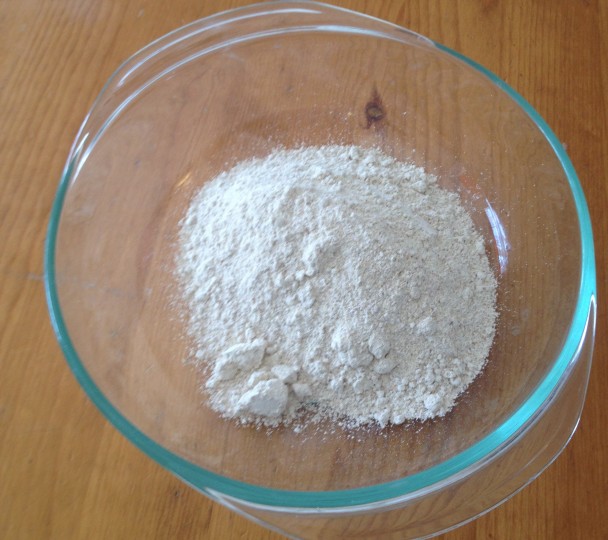
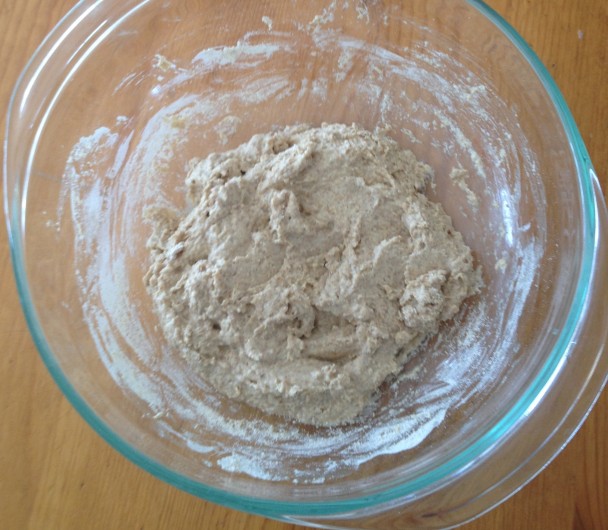
Day 3: Discard half of the start and feed it again with 120 grams of flour and 120 grams of water. (The discard process is to keep you from ending up with more start than you know what to do with.)
Day 4: Repeat process from day 3.
Day 5: Repeat process from day 3 and 4. Keep doing this every morning until it has that bubbly root beer float texture and smells slightly sour. I can’t give you an exact day count. It just depends. Below is a picture of how it should look. (I switched bowls part way through the process just for cleanliness, but this is the same start pictured above)
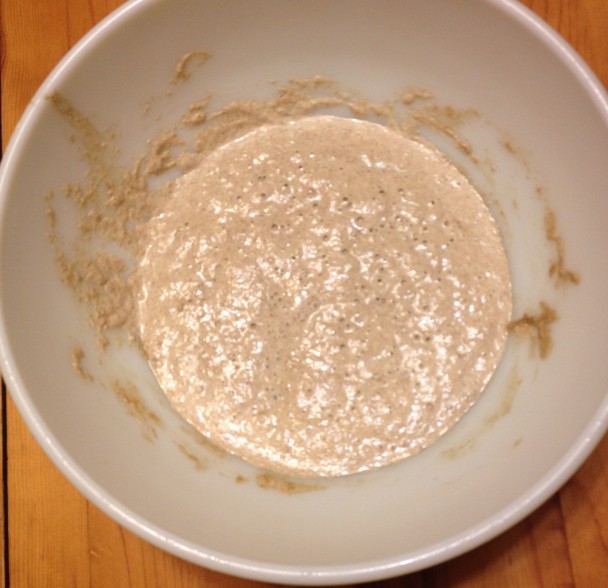
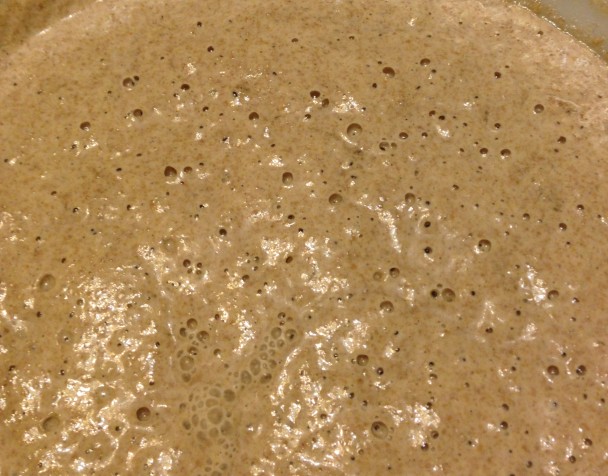
I have seen many things on the internet about how to make a sourdough start. You are welcome to try any method you choose. I am not suggesting that this is the only way to make it work, but this is how I got it to work. Good luck!

76 thoughts on “How to Create Your Sourdough Start Using Einkorn”
I am new to Einkorn flour and excited to try it. Would a sour dough starter that has been made from instant potatoes, sugar and water work with this recipe? Thanks so much.
Hi Brenda, any viable sourdough starter can be fed with einkorn flour and used in any of our sourdough recipes.
When feeding the viable starter I have, should I use half the amount of water that is originally called for in that recipe to feed the starter since Einkorn flour doesn’t absorb water like other wheat? Also, would it be necessary to add the potato flakes since the starter is viable? Thank you so much for your help.
Hi Brenda, when feeding a sourdough start with einkorn, we recommend twice as much flour as water (we usually do 2 cups of flour and 1 cup of water) The potato flakes will not be necessary in a viable starter.
Why oven light off vs on? I’ve heard advice to keep the light on. I’m not challenging your advice, just trying to understand it so that I do the right thing.
Also, the WAP foundation web info doesn’t talk about the parchment and damp towel. can you please explain this and does the parchment go underneath the towel or on top of it? I’m assuming on top so that it doesn’t dry out? And you do this between feedings until the starter is ready to use for bread?
Thanks!
Hi Susan, it may work fine with the light on. I found that my counter was slightly too cold and I thought it would get a little too warm with the oven light on. You’ll have to see what works best in your kitchen. You can look at this article for where I obtained the parchment and damp towel idea. Scroll down to where it says “Making your Starter.” Yes, the parchment will go under the towel. I kept it covered that way after every stage, yes. Once the start is going, I don’t store it that way. We just keep it in a small jar in the refrigerator until the night before we want to use it. Then, we remove it and feed it with flour and water and let it sit with just a towel over it until the morning when we’re ready to use it in a recipe. I hope that helps.
I too was using the recipe from Carla Bartolucci to make Einkorn sourdough starter and became confused. My starter is a week old, has never been refrigerated, and I have continued to feed it, therefore, it is a large quantity. Is it still good to use since I have just continued to feed it up to three times per day?
Thank you for your help! 🙂
Hi Kathy, It is probably fine to use. I’m not very familiar with her method for making a sourdough starter, so I don’t know what to tell you about the feeding. We don’t feed ours that often. When I was creating a starter from the ground up, I fed it once a day. Once a start is established, we keep a very small amount in the refrigerator and only feed it when we want to use it the next day. So, we feed it at night and it’s read to work with in the morning. I hope that helps.
Do you have the recipe to make the actual sourdough bread after making the starter? I have always wanted to try a starter, but do not know how to use it once it is finished.
Thanks!
Hi Samantha, we do have sourdough recipes. Go here to see our sourdough bread recipe and here for more cool things you can do with that same recipe!
Flour water salt let it sit and ferment. It will sour more or less depending on the amount of water and salt you use. You can really change the flavor up by changing the salt or the kind of salt you use. I go through a huge bowl everyday and replace. By the next day it has finished. Bread will rise off of mine in a few hours and much faster if put in dehydrator around 90 degrees covered. Never throw any away. We go through 50 pounds of wheat in about 4 months. Amazing how easy this process all is and how lazy the rest of the world has become.
have only glanced at this thread, but surprised at some of the basic rules. closed plastic container in fridge is best for long-term keeping of any grain starter. of course there’s a foul smell in the first 3 or 4 days making new starter . . . it’s the bad bacteria dominating, but eventually killed off by the more acid friendly bacteria which start to dominate. for the same reason it isn’t at all necessary to keep everything sterile. in fact quite the opposite. just read some of the scientific articles on starters and sourdough in general. actually, for long-term keeping, it’s best to mix up stiff mix with a narrow tool (skewer?) so that the gluten isn’t developed. then that horrid brown liquid shouldn’t appear.
Hi! I had been using another brand of Einkorn flour to make sourdough bread (I have a successful starter made with the whole grain version of that brand), and it has baked up wonderfully. I ordered your flour recently and am using it to bake my first batch of bread. What I notice is that after the overnight rise, the dough rises well, but when I turned it onto a floured board for shaping before the final rise (using a dough scraper and the “folding in thirds” method) it was much looser and stickier than I am used to, even when dusted with additional flour. I used the same recipe as with the other brand.
Do brands of Einkorn flour differ in properties? The other brand is grown in Italy.
Hi Rose, yes, different brands of einkorn will behave slightly differently. They’ll both be einkorn and be essentially the same but they will be slightly different strains. For this reason, I suggest that you not become too attached to exact measurements, but pay more attention to consistency. For einkorn dough to be a little sticky is actually ok. Sometimes, if it’s not sticky at all, the bread will come out very dense. It’s difficult to work with when it’s sticky but can still bake beautiful bread. Sometimes, we’ll just put a little oil on our hands to help with that.
So appreciative of your blog and all the info. Like Iola I have had a hard time understanding the directions from that particular recipe book. It seems as tho your directions are not quite as rigid and much easier to understand. A million thanks. Roberta
Hi Roberta, thank you for the feedback. Yes, sourdough is not an exact science and there are multiple ways to do it. This is what we’ve found works for us. I hope it’s helpful to you, too.