
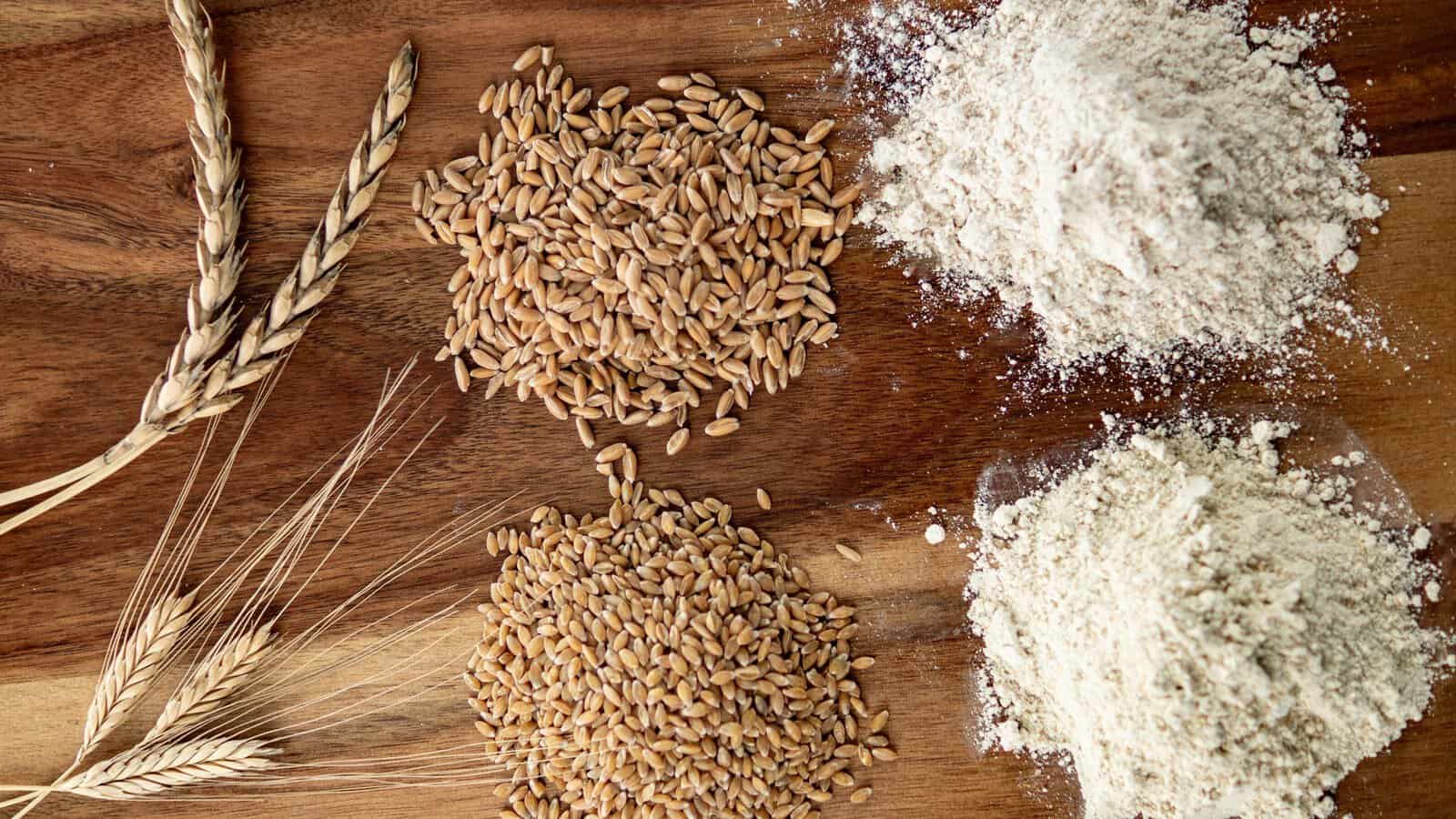
A lot of people who order our einkorn flour haven’t eaten bread in years. They come for their health, open the bag, bake a favorite recipe the way they always have, and end up with a sticky dough that won’t rise like they expect. So what’s actually different between a bag of einkorn and the bag of regular flour in your pantry?
Quite a lot, and the research is clear on it. Einkorn is a different wheat, with 14 chromosomes to modern wheat’s 42. Its gluten is built from a different balance of proteins. It has none of the 33-mer, the most reactive gluten fragment, and less than 5% of the ATIs found in other wheats, proteins researchers link to non-celiac wheat sensitivity. On USDA’s numbers it has 61% more zinc than whole wheat flour, and it carries several times the lutein of bread wheat.
In this article I’ll put einkorn flour side by side with all-purpose, bread and whole wheat flour: what’s in each bag, how each one bakes, how the nutrition compares, and when to reach for which.
The short answer: Einkorn flour comes from einkorn, the original wheat. Regular all-purpose, bread and whole wheat flours come from modern bread wheat. Einkorn has more gluten than common wheat, with a different balance of gluten proteins, so its dough is soft and sticky and rises less. Per 100 grams it has 61% more zinc than whole wheat flour and the same protein, and several times the lutein of bread wheat. Whole wheat flour has more fiber. Einkorn is not gluten-free and is not safe for anyone with celiac disease or a wheat allergy.
Einkorn vs regular flour at a glance
| Einkorn flour | All-purpose and bread flour | Whole wheat flour | |
|---|---|---|---|
| Wheat | Einkorn (Triticum monococcum) | Modern bread wheat (Triticum aestivum) | Modern bread wheat (Triticum aestivum) |
| Chromosomes | 14 (A genome only) | 42 (A, B and D genomes) | 42 (A, B and D genomes) |
| Whole grain? | Whole grain einkorn: yes. Our all-purpose einkorn keeps 85% of the grain | No, refined | Yes |
| Gluten | More than common wheat, with much less glutenin | Strong, stretchy | Strong, stretchy |
| 33-mer gluten fragment | Below detection | Present in every bread wheat tested | Present in every bread wheat tested |
| Dough | Soft, sticky, rises less | Elastic, rises tall | Elastic, rises well |
| Color | Golden, from lutein | White | Tan |
| Best for | Quick breads, pancakes, cookies, pan loaves, sourdough, pasta | Tall, open loaves | Hearty sandwich bread |
Einkorn is a different wheat
Every bag of regular flour at the store, all-purpose, bread or whole wheat, is milled from modern bread wheat. Bread wheat carries three sets of genes, called the A, B and D genomes, and 42 chromosomes. Einkorn, the first wheat people farmed about 10,000 years ago, carries only the A set and 14 chromosomes (Molberg et al., 2005).
That missing D genome shows up in the flour. The D genome carries the 33-mer, the gluten fragment that sets off the strongest immune reaction in celiac disease. When German researchers tested 38 bread wheats and 2 spelts, every one contained it. In einkorn it was below detection (Schalk et al., 2017).
We cover the grain side of this story, from the wild grasses to modern breeding, in einkorn vs modern wheat.
How einkorn’s gluten differs
Most people expect einkorn to be a low-gluten flour. It isn’t. Grown side by side with common wheat at four test sites, einkorn had more protein and more gluten at every one (Geisslitz et al., 2019).
The difference is the mix. Gluten is two kinds of protein, gliadin and glutenin, and glutenin is the one that gives regular dough its strong, stretchy structure. Einkorn’s gluten carries about 6.5 parts gliadin for every part glutenin. Common wheat carries about 2.5. Einkorn had 10.3 mg of glutenin per gram against 16.6 mg in common wheat.
That one fact explains most of what bakers notice. With less glutenin, einkorn dough is softer and stickier, traps less gas, rises less, and needs very little kneading. A higher protein number on an einkorn bag doesn’t make it behave like bread flour.
The proteins differ in a second way that matters to people who come to einkorn for digestion. Einkorn had less than 5% of the amylase-trypsin inhibitors (ATIs) found in the other wheats tested (Geisslitz et al., 2020). ATIs are wheat proteins researchers link to non-celiac wheat sensitivity. The full research is in is einkorn easier to digest?
Einkorn flour vs all-purpose and bread flour
All-purpose and bread flour are refined: the bran and germ are milled out, leaving the white endosperm. Bread flour is the strong one, made for tall, open loaves.
Our all-purpose einkorn is sifted too, but lightly. It keeps 85% of the whole grain, with only some of the bran and germ taken out, and it’s unbleached and unbromated with nothing added. It has a slight yellow tint from its lutein.
In the kitchen, here’s what changes when you use einkorn in place of all-purpose or bread flour:
- The dough is sticky. That’s normal. Don’t add flour to fix it, or you’ll bake a brick.
- It takes less work. Einkorn needs very little kneading. We knead it on low in a mixer for about 4 minutes.
- It rises less. Einkorn dough can collapse if you wait for it to double the way bread flour dough does. Bake it a little sooner.
- It handles liquid differently. For dough breads, hold back some of the liquid and add it as the dough comes together. Whole grain einkorn works as written in pancakes, waffles, muffins and banana bread.
- It bakes up golden. The color is lutein, and in a bread-making trial einkorn breads kept most of it through baking: 58% to 76%, against 16% to 20% for wheat breads (Antognoni et al., 2017).

When you need a tall baguette or a big open crumb, bread flour is the easier tool. For quick breads, pancakes, cookies, pie crust, tortillas, pasta and pan loaves, einkorn is the flour we reach for. Our einkorn flour substitution guide has the cup and gram conversions for all-purpose flour.
Einkorn flour vs whole wheat flour
Is einkorn flour whole wheat? Whole grain einkorn flour is. Einkorn is a wheat, and our whole grain einkorn flour keeps the whole kernel, which is why we sell it as Organic Einkorn Whole Wheat Flour. Our all-purpose einkorn is sifted, so it is not a whole grain flour.
So the real comparison is whole grain against whole grain, einkorn against modern wheat. Here’s how they line up per 100 grams on USDA’s numbers:
| Per 100 grams (USDA) | Einkorn grain | Whole wheat flour | Hard red winter wheat |
|---|---|---|---|
| Protein | 15.1 g | 15.1 g | 12.6 g |
| Fiber | 8.91 g | 10.6 g | 12.2 g |
| Zinc | 5.23 mg | 3.24 mg | 2.65 mg |
| Phosphorus | 436 mg | 352 mg | 288 mg |
Einkorn has 61% more zinc than whole wheat flour and more phosphorus. Protein is even on USDA’s numbers. Whole wheat flour has more fiber.
Lutein is the big gap. In lab measurements, einkorn had 3.5 to 3.7 times the lutein of bread wheat (Abdel-Aal et al., 2007), which is why whole grain einkorn bakes up golden where whole wheat bakes up tan.
In the kitchen, whole grain einkorn behaves like all-purpose einkorn with more bran in it: soft and sticky, and it rises less and can collapse if left too long. Fresh-milled whole grain einkorn takes more liquid than all-purpose einkorn does. The substitution guide has a section on whole grain einkorn for whole wheat flour.
Is einkorn flour healthier than regular flour?
On most of what people buy it for, yes.
- Protein and vitamin E. In a field trial where both were grown side by side in the same fields, einkorn had 59% more protein and 46% more vitamin E than bread wheat (Hidalgo et al., 2009).
- Minerals and lutein. USDA lists einkorn at about twice the zinc of hard red winter wheat and 61% more than whole wheat flour, and it has several times the lutein of bread wheat.
- Lower blood-sugar response. In a randomized trial with 16 healthy adults, einkorn sourdough bread gave about a 12% lower blood-sugar response than commercial wheat bread, and people felt almost twice as full afterward (Bo et al., 2017).
- Wheat-sensitivity proteins. Less than 5% of the ATIs and none of the 33-mer, as above.
Whole wheat flour wins on fiber. And einkorn is still wheat with gluten, so it is no answer for celiac disease. Our einkorn nutrition facts page has the full panel.
Why einkorn flour costs more than regular flour
Einkorn grows in a hull that stays on through harvest, so every kernel has to be dehulled before milling. It’s a difficult crop to farm, and ours is certified organic and never sprayed with glyphosate. We mill it to order on a stone mill that only grinds einkorn, and the mill date is printed on the bag. As of October 2026, our all-purpose einkorn runs as low as $3.60 a pound and our whole grain einkorn as low as $3.32 a pound in the larger bags. The full breakdown is in why einkorn flour costs more.
Who should not use einkorn flour
People with celiac disease. Einkorn contains gluten. Researchers who tested einkorn bread in celiac patients concluded it is “not suitable for the diet of celiacs” (Picascia et al., 2020). We always tell people with celiac disease not to eat gluten, and einkorn contains gluten. More in is einkorn gluten-free?
People with a wheat allergy. Einkorn is wheat.
For everyone else, a good place to start is our all-purpose einkorn flour in a batch of pancakes, then a loaf of bread once you know how the dough feels.
Frequently asked questions
Can I use einkorn flour instead of all-purpose flour?
Yes. Hold back some of the liquid in dough breads, knead briefly, and bake before the dough doubles. Whole grain einkorn works as written in pancakes, muffins and banana bread. Our substitution guide has the conversions.
Can I use einkorn flour instead of bread flour?
Yes, with the same changes, but expect a shorter, softer loaf. Einkorn has far less glutenin than bread wheat, so it can’t build the tall, open structure bread flour is made for. A loaf pan helps.
Is einkorn flour whole wheat?
Whole grain einkorn flour is: einkorn is a wheat, and the whole kernel stays in the flour. All-purpose einkorn flour is sifted and keeps 85% of the grain.
Is einkorn better than whole wheat flour?
Per 100 grams, einkorn has 61% more zinc, more phosphorus and several times the lutein. Protein is even on USDA’s numbers, and whole wheat flour has more fiber.
Is einkorn flour low in gluten?
No. Einkorn had more gluten than common wheat in a four-site field trial. Its gluten has much less glutenin, which is why the dough is soft.
Is einkorn flour healthier than regular flour?
On most counts, yes. Grown side by side with bread wheat, einkorn had 59% more protein and 46% more vitamin E. It has 61% more zinc than whole wheat flour and several times the lutein of bread wheat. Einkorn sourdough bread gave about a 12% lower blood-sugar response than commercial wheat bread in a randomized trial. Whole wheat flour has more fiber.
Does einkorn flour rise like regular flour?
No. It rises less and can collapse if left to double. Bake it a little sooner than a regular loaf.
Is einkorn safe for people with celiac disease?
No. Einkorn contains gluten and is not safe for anyone with celiac disease or a wheat allergy.
