
I read Lina Zeldovich’s Smithsonian story about Claudio Grossi the other week and kept thinking about our own family farm. Grossi brought an old wheat back into cultivation near Parma, Italy. I liked his willingness to keep growing it while he learned what it needed.
His wheat is called grano del miracolo, or miracle wheat. We grow einkorn here in Teton, Idaho. They are different wheats, with some familiar challenges in the field and the kitchen. If the story left you wondering how an old wheat would work in your own baking, einkorn is one we can help you get to know.
The grain in the Smithsonian story
Grossi grew the wheat from seeds he found in an old family sack. Its branched heads reminded him of Pharaoh’s dream in Genesis. Later, a University of Parma investigation identified it as poulard wheat, Triticum turgidum.
The Emilia-Romagna regional register independently places grano del miracolo in the T. turgidum group and names Grossi’s farm as its seed multiplier. It also documents the name in nineteenth-century sources. Grossi helped revive a wheat with a history that long predates his discovery.
The part about flavor caught my attention, too. The story describes a nutty aroma and a sweetness Grossi finds missing in commercial flour. Flavor is a good reason to try an old wheat. Our einkorn has a sweet, nutty taste of its own, and you can taste it in something as ordinary as a pancake.
The Bible passages that stayed with me
Grossi connected his wheat with Genesis 41:5–7, where Pharaoh dreams of seven full ears of grain growing on one stalk, followed by seven thin ears. Joseph interprets the dream as years of plenty followed by famine.
I appreciated that part of his perspective. Faith is part of our family’s life on the farm, too. We pray about the weather and the water, and we’re grateful for the food a harvest gives us.
Two other passages mentioned alongside the story are ones I like. In 1 Kings 17:8–16, Elijah and the widow at Zarephath have flour and oil that last through the drought. In 2 Kings 4:42–44, Elisha feeds a hundred people with twenty barley loaves, with food left over.
Those passages mean something to a family that grows grain. Genesis does not name the wheat in Pharaoh’s dream, so it doesn’t establish the identity of Grossi’s grain or einkorn. I like the connection he made without needing the passage to answer a botanical question.
Growing old wheat in difficult weather
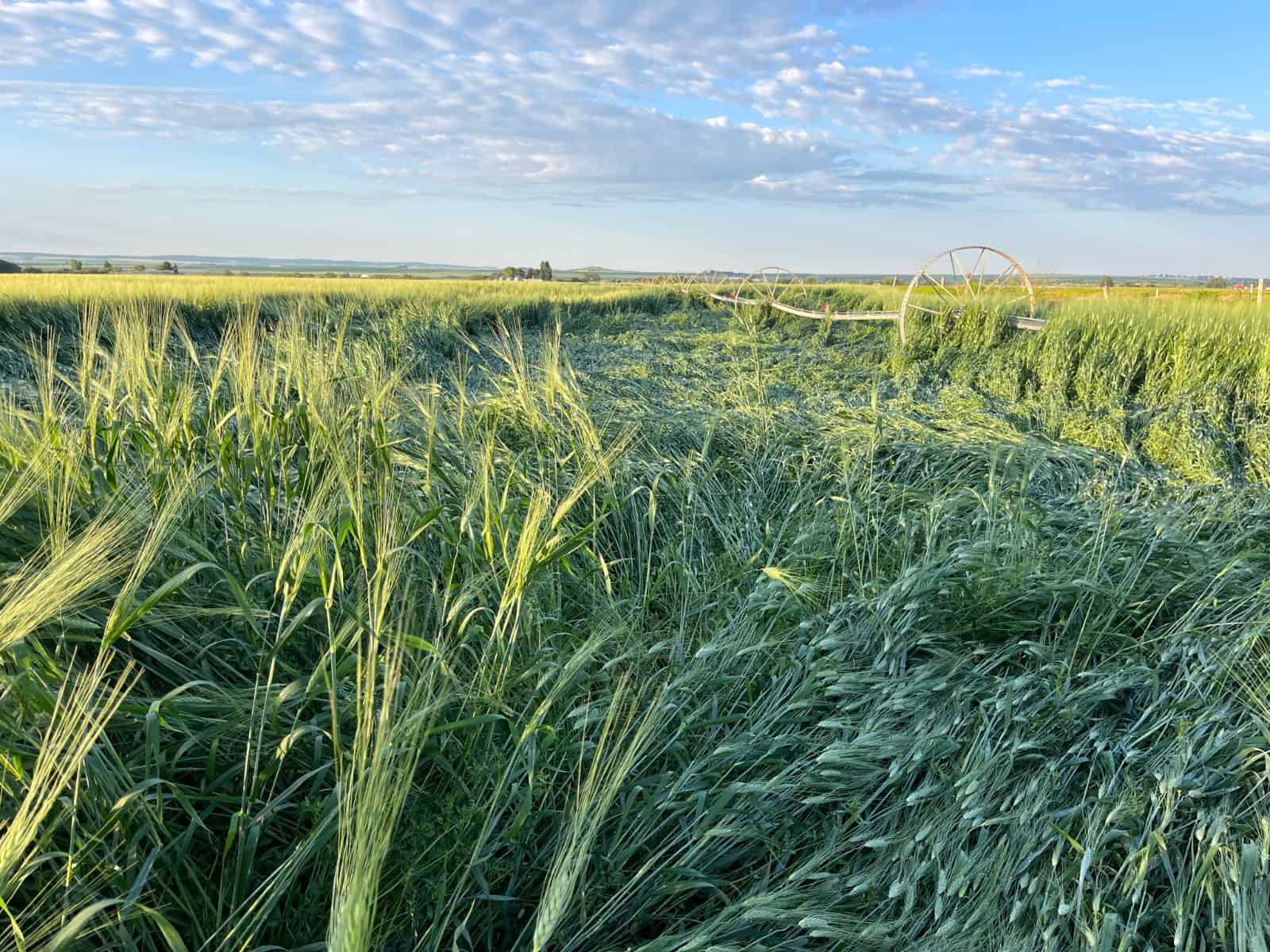
The weather in Grossi’s story is familiar. Wind, rain and hail can flatten his tall wheat before harvest. We’ve struggled with difficult weather on our own farm, too.
That shared difficulty matters when I read about an old grain’s resilience. A crop can have useful strengths and still be vulnerable to a storm. Height helps a plant compete with weeds, but it also gives the wind more stalk to push over.
We keep working on how we grow einkorn because we value the grain enough to learn its demands. Grossi has been doing that with a different wheat. The connection between our farms makes more sense once you know where each grain fits in the wheat family.

Is miracle wheat the same as einkorn?
The wheat identified in the story is poulard wheat, Triticum turgidum, with 28 chromosomes. Einkorn is Triticum monococcum, with 14. Modern bread wheat, Triticum aestivum, has 42. Einkorn belongs to an earlier branch of wheat’s history; the chromosome count describes its genetic structure and doesn’t tell you how much gluten a flour contains.
Here is how both compare with bread wheat.
| Trait | Einkorn | Italy’s miracle wheat | Modern bread wheat |
|---|---|---|---|
| Species | Triticum monococcum | Triticum turgidum, poulard type (also called rivet wheat) | Triticum aestivum |
| Genomes and chromosomes | Diploid, AᵐAᵐ, 14 | Tetraploid, AABB, 28 | Hexaploid, AABBDD, 42 |
| Where it came from | The first domesticated wheat, about 10,000 years ago, in southeastern Turkey | A free-threshing descendant of domesticated emmer; grown around Parma since at least the early 1900s | Its A genome came from wild Triticum urartu; about 1% of that genome later came from einkorn |
| Height | Mean 107 cm (about 42 in), range 64 to 120 cm, even with a growth regulator, in the Hohenheim trial; about 30 cm (12 in) taller than bread wheat in a separate four-site trial | “Very tall” in the regional register; about six feet on Grossi’s farm | 83 to 87 cm (about 33 to 34 in) for two current varieties in the Hohenheim trial |
| Hull | Hulled: the kernel stays in its hull at harvest and must be dehulled | Free-threshing: the kernel comes free of its hull at threshing | Free-threshing |
| Yield | 3.8 to 6.1 metric tons per hectare (t/ha), hulls on, in the Hohenheim trial; grain yield 62% below bread wheat in a separate four-site trial | Rivet wheat in general: 2 to 2.5 t/ha | About 8.2 to 8.5 t/ha in the Hohenheim trial |
| What it needs to grow | Grown at a third of the usual wheat nitrogen rate in the Hohenheim trial, to limit lodging; more frost hardy than two frost-hardy winter wheats; falls over (lodges) in storms; needs good weed control; valued for low-input farming and pest and disease resistance | Rivet wheat in general: grows in poor soils, competes well with weeds, good disease resistance. Grossi’s wheat: no fungal disease seen in more than 10 years of growing it, per the regional register; very prone to lodging | Semi-dwarf, bred to respond to fertilizer and resist lodging |
| Gluten | Has gluten: more than common wheat, with a weak structure; gliadin to glutenin ratio 6.5. Not for anyone with celiac disease | Smithsonian reports lower gluten in the Parma research; the article does not provide the measurements or methods. Results for einkorn cannot be transferred to this grain | Strong and elastic; gliadin to glutenin ratio 2.5 |
| Nutrition notes | Most protein of all the wheats in a 2019 study; zinc 5.23 mg per 100 g | Poulard samples had the most phosphorus, potassium, magnesium and calcium in the same 2019 study; these were not measurements of Grossi’s crop | Zinc 2.65 mg per 100 g in hard red winter wheat |
| How to bake it | Knead little; support the dough in a pan or form; less yeast, or sourdough | Grossi’s fixes: smaller batches, less kneading, tall baskets | Tolerates long, intensive kneading |
For six wheats side by side, see our einkorn vs. modern wheat comparison.
Where einkorn fits in wheat’s history
Einkorn is older. It is the first domesticated wheat: farmers in the Karacadağ mountains of southeastern Turkey domesticated it about 10,000 years ago. Grossi’s poulard wheat, also called rivet wheat, is one of the free-threshing wheats that came later, out of domesticated emmer.
Einkorn carries one genome, Aᵐ; Grossi’s wheat carries A and B; bread wheat carries A, B and D. Our page on what einkorn is tells the longer story.
Einkorn is not the parent of the other two. The A genome in poulard, durum and bread wheat came from wild Triticum urartu, a close relative of einkorn. Einkorn stayed its own crop, though old hybrids and modern breeders have moved small pieces of it into bread wheat: about 1% of bread wheat’s A genome is einkorn DNA, and breeders have gone back to einkorn for genes that resist rust disease.
What makes an old wheat different?
An old name tells you very little about a bag of flour. The species, the way it was grown and the way you bake it give you much more to go on.
Einkorn has its own genetic identity. It is a hulled wheat, so we have to remove the hull after harvest. Its dough behaves differently from bread-wheat dough, and researchers have measured differences in its gluten proteins. Those are useful distinctions when you’re choosing flour.
The farm matters, too. We grow our einkorn alongside clover and alfalfa, and we run our own cleaning and milling facility. That lets us grow a mixed field and still clean the einkorn for your kitchen. Our page on how einkorn is grown explains more of that work.
Baking with a weaker gluten structure
Einkorn dough can collapse when it overproofs or is overworked. Its weaker gluten structure needs gentler handling than bread-wheat dough. A sourdough baker who mixed about 30% Miracolo flour into bread flour wrote in a 2020 comment on Stir the Pots that “It makes the shaping almost impossible.” A longtime 100% einkorn baker wrote on The Fresh Loaf in 2018 that dough left on the board for more than a few minutes turned into “a puddle of ooze.” More flour gives you a brick, and harder kneading breaks down what gluten the dough has.
Gluten has two main parts, gliadin and glutenin, and too much gliadin makes a soft dough. In a 2019 study of 15 einkorn varieties grown at four sites, einkorn gluten carried 6.5 parts gliadin for each part glutenin, against 2.5 in common wheat, which makes an elastic dough that holds gas (Geisslitz et al. 2019, Foods). The Hohenheim researchers wrote: “Over-kneading of the dough should absolutely be avoided for einkorn.”
Grossi’s baker used less kneading and tall wicker baskets. That approach will sound familiar if you’ve baked einkorn. These are the adjustments I recommend:
- Use less water than your usual recipe. In a 2015 interview I told home bakers to “reduce the water by 25-50%, and then don’t fall into the temptation of adding more flour.”
- Handle sticky dough with wet hands.
- Mix until the dough comes together, then stop. Knead little or not at all.
- Give the dough a wall to rise against. A loaf pan, a banneton or a Dutch oven does the job Grossi’s tall wicker baskets did.
- Let it rise less, and watch it. Weak dough can collapse if you leave it to double.
- Watch your sourdough’s timing. Our einkorn sourdough process took about half the time of our previous one. Your starter and kitchen temperature will affect yours.
My wife, Julie, has worked hard on this. Her einkorn loaves are beautiful and tall, and I give her the credit for figuring out how to bake them. Her tips for baking with einkorn flour go deeper on hydration, mixing and rising.
Does miracle wheat have less gluten than modern wheat?
This takes a little unpacking, because the amount of gluten and the way that gluten behaves are different questions.
For Grossi’s miracle wheat, Smithsonian reports that the Parma research found less gluten than modern wheat. That’s a finding worth following up on. The article doesn’t give the underlying measurements or methods, so it doesn’t tell us how large the difference was or how it would vary between harvests.
For einkorn, published research gives us a much fuller answer. Einkorn has less of some gluten components, a weaker gluten structure and evidence of differences during digestion. It can also have more total gluten than modern bread wheat.
Less glutenin, with a weaker dough structure
Gluten includes gliadins and glutenins. Glutenins help give bread dough its strength and elasticity.
In a 2019 study of five wheat species, einkorn averaged 10.3 milligrams of glutenin per gram of flour, compared with 16.6 in common bread wheat. Its balance was different, too: about 6.5 parts gliadin to one part glutenin, compared with 2.5 in bread wheat. Total gluten was higher in einkorn in that study.
So there is a measurable reduction in the strength-building glutenin portion. Calling einkorn “low gluten” loses the distinction that matters. Its particular mix of gluten proteins helps explain why it makes a softer, stickier dough that needs less kneading.
Different gluten fragments during digestion
There is published evidence here as well. A 2020 study using human digestive juices found 38 distinct gluten peptides containing celiac-related immune triggers after digesting the einkorn sample. The four common-wheat samples produced between 72 and 155.
That experiment took place outside the body. It gives researchers a reason to investigate differences in how these wheats are digested; it doesn’t measure how comfortable someone feels after eating a loaf.
A separate 2017 analysis did not detect the 33-mer gluten fragment in the einkorn samples tested, while detecting it in all 38 bread-wheat samples. Einkorn lacks the D genome associated with that fragment. Other immune-triggering gluten fragments remain.
What people report about eating einkorn
We hear from customers who had given up ordinary bread and say they do better with einkorn. I take those experiences seriously. They help explain why people keep baking with it, and the research gives us specific protein differences to investigate.
What we still need is stronger human evidence explaining who tolerates einkorn better and why. Flour extraction and fermentation also change a loaf, so a person’s experience with one bread doesn’t isolate the grain alone.
Einkorn contains gluten and is not safe for people with celiac disease or a wheat allergy. For the wider question about older wheat, we already have evidence of different gluten composition and digestion. Research is still working out how those differences translate into people’s everyday experience.
Other measured differences in einkorn
Gluten is one part of the picture. Researchers have also measured differences in amylase/trypsin inhibitors, wheat proteins known as ATIs, and in einkorn’s carotenoid pigments. Those findings belong alongside the gluten research when we talk about what makes this grain interesting.
Why did tall old wheats disappear from farms?
They give a farmer far less grain. In a four-site field trial, einkorn yielded 62% less than bread wheat. Picture one field: for every 100 pounds of bread wheat it would grow, it grows about 38 pounds of einkorn. Every einkorn kernel has to come out of its hull, and in the Hohenheim trial the kernels were only 59% to 73% of the harvested weight once the hulls came off. Tall straw also lodges in storms.
Italy’s Battle for Grain, a government campaign for self-sufficiency in wheat, began in 1925. Its main tools were Nazareno Strampelli’s short, early wheats, several of them bred from his 1913 cross with the Japanese wheat Akakomugi. Later, short-straw genes from another Japanese wheat, Norin 10, went into Norman Borlaug’s semi-dwarfs and from there into most of the world’s wheat. These green revolution wheats were bred to respond to fertilizer and to stay standing in wind and rain. A University of Minnesota history of Borlaug’s work calls his Mexican semi-dwarfs “Miracle Wheat.”
Why we keep growing einkorn
Einkorn remained a separate crop through the development of modern bread wheat. It still grows tall and yields far less. As free-threshing wheats replaced it, einkorn held on as a relic crop in isolated mountain areas of a few countries, and a 2014 review credits the renewed interest in it to “its adaptation to low-input agriculture and high level of resistance to pests and diseases”.
We make that trade on purpose. On our farm we don’t use herbicides or pesticides of any kind, and our einkorn grows alongside clover and alfalfa. We clean and mill it ourselves. It is a difficult crop, and we’re committed to it.
My own work with einkorn started at one of our kids’ music recitals in 2009, when a friend told me about einkorn. With a translator’s help I got my first seed from a farmer in Germany. The first crop, planted by a farmer in Wyoming in 2010, failed because the German seed was a fall variety and went in the ground in spring. The fall crops of 2011 worked, one of them on my father’s farm in Gooding, Idaho. Today we keep and replant our own einkorn seed. Follow a season on our farm in how einkorn is grown.
Frequently asked questions about miracle wheat and einkorn
Can I plant einkorn berries from a bag?
Some will sprout. Removing the hull lowers germination, and when we tested our einkorn berries, 40 to 50% sprouted.
Is einkorn a biblical grain?
Einkorn is one of the earliest domesticated wheats, with a history that reaches back to the beginnings of farming. The Bible doesn’t identify it by name. The grain in Genesis 41 is described by its ears, which gives us a meaningful picture without identifying a species.
What about America’s historical “Miracle” wheats?
The name has been used for different wheats. In 1908 the University of Idaho tested a branched poulard wheat sold as “Alaska wheat” from Juliaetta, Idaho, and a 1916 USDA bulletin lists “Miracle” among its sales names. The “Miracle” wheat sold in 1911 was a different variety, an ordinary soft red winter wheat.
Can I buy miracle wheat flour in the US?
Molino Grassi sells flour under the Miracolo trademark. Its own account of the supply chain describes several revived grain varieties, so check the ingredients of the particular flour you find. The brand name alone doesn’t establish that a bag contains only Grossi’s branched wheat. Einkorn is a separate old wheat that we grow and mill here in Idaho.
Your first loaf with einkorn
If you’d like to bake with an old wheat, einkorn is the one we grow and know. Give the dough a little support and time to get used to its feel.
Even if you keep a sourdough starter, bake one yeast loaf first this week. Yeast bread is more forgiving, and einkorn sourdough moves faster than the sourdough you know. Use all-purpose einkorn flour, follow the six steps and bake in a loaf pan.
We grow our einkorn on our family farm in Teton, Idaho, and with a few neighbors we know. It is certified organic and tested for glyphosate. We combine it so the kernel stays in its hull, and we mill it after you order on a mill that runs nothing but einkorn, with the mill date printed on the bag. Order our organic all-purpose einkorn flour and start with one of our tested einkorn bread recipes.
