
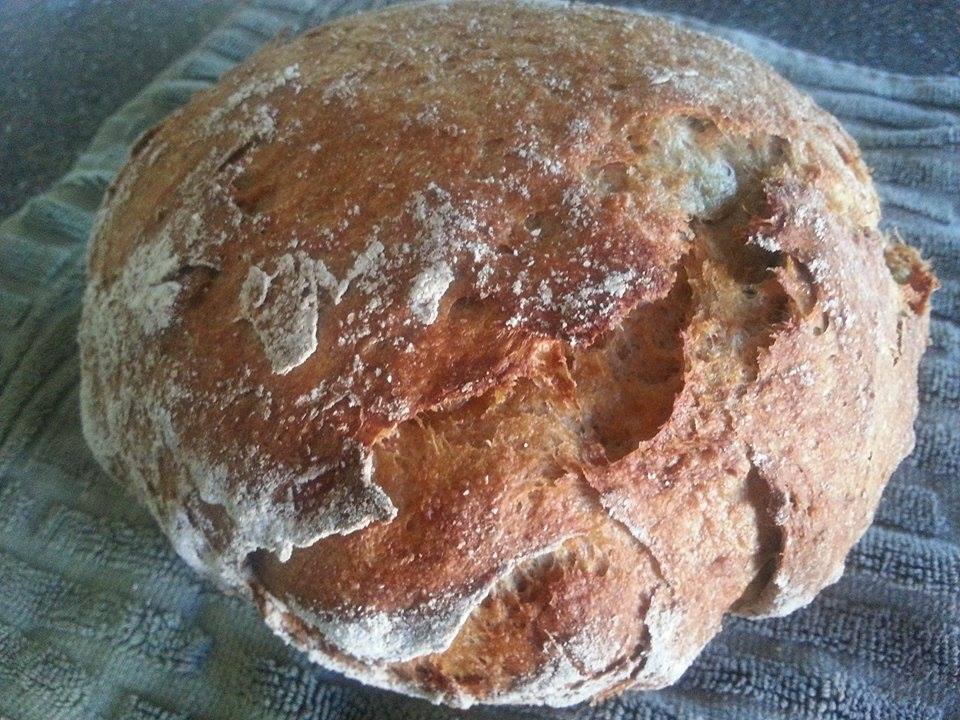
 This slow rise einkorn bread is really quite a treat. Is there anything quite like an artisan bread that has slowly developed flavors, with a hard crust and chewy middle? No, no there really isn’t. The key to the beautiful crust is a dutch oven. The heavy pot with the tight lid that seals on top simulates a professional bread oven circulating the stem back upon itself. It’s as close as we will get to the real thing here at home.1. Proof 1/2 tsp of yeast in the warm water. I tend to go a little on the hotter side, as long as you don’t go over 110 degrees you are ok.2. Sift 5 Cups of Einkorn flour, 1/2 tsp sea salt, and 1/3 c powdered milk together.3. Add the water/yeast mixture into your dry ingredients and mix with a spatula. The dough will be fairly sticky.4. Scrape the sides of your bowl down to incorporate then cover with plastic wrap.5. Let it rise for 14 hours in a dark place. The slow rise develops volume and flavor at the same time.6. After 14 hours preheat your oven to 500 with the dutch oven AND lid in the middle of your oven. This dutch oven is the key to the artisan type of bread.7. Turn your dough out onto a floured surface. Don’t work the dough too much. I fold each side of the dough inward like an envelope to create some more pockets of air.8. Once your oven is preheated, place your loaf into the dutch oven, place the lid on it and close your oven. Do this as quick as possible so you do not lose your heat.9. Bake for 35 minutes, take the lid off and bake for another 5-10 minutes.10. Cool on a rack until completely cool.11. Enjoy!(For a more detailed version of this recipe go, HERE)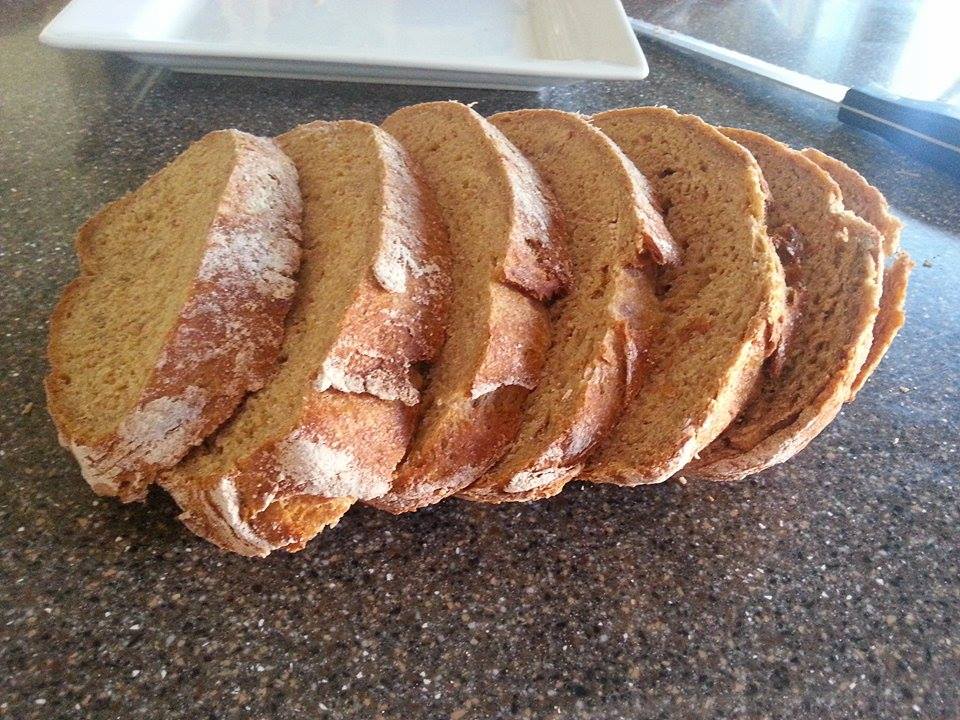
 Enjoy making this VERY simple beautiful Einkorn Rustic slow rise no worry bread.
Go here, for a deeper explanation on this recipe.
1. Proof your yeast in the warm water.
2. Sift flour, salt, and powdered milk together.
3. Add the water to your dry ingredients and mix with a spatula. The dough will be fairly sticky.
4. Scrape the sides of your bowl down to incorporate then coverwith plastic wrap.
5. Let it rise for 14 hours in a dark place. The slow rise develops volume and flavor at the same time.
6. After 14 hours preheat your oven to 500 with the dutch oven AND lid in the middle of your oven.
7. Turn your dough out onto a floured surface. Don't work the dough too much. I fold each side of the dough inward like an envelope to create some more pockets of air.
8. Once your oven is preheated, place your loaf into the dutch oven, place the lid on it and close your oven. Do this as quick as possible so you do not lose your heat.
9. Bake for 35 minutes, take the lid off and bake for another 5-10 minutes.
10. Cool on a rack until completely cool.
11. Enjoy!
Enjoy making this VERY simple beautiful Einkorn Rustic slow rise no worry bread.
Go here, for a deeper explanation on this recipe.
1. Proof your yeast in the warm water.
2. Sift flour, salt, and powdered milk together.
3. Add the water to your dry ingredients and mix with a spatula. The dough will be fairly sticky.
4. Scrape the sides of your bowl down to incorporate then coverwith plastic wrap.
5. Let it rise for 14 hours in a dark place. The slow rise develops volume and flavor at the same time.
6. After 14 hours preheat your oven to 500 with the dutch oven AND lid in the middle of your oven.
7. Turn your dough out onto a floured surface. Don't work the dough too much. I fold each side of the dough inward like an envelope to create some more pockets of air.
8. Once your oven is preheated, place your loaf into the dutch oven, place the lid on it and close your oven. Do this as quick as possible so you do not lose your heat.
9. Bake for 35 minutes, take the lid off and bake for another 5-10 minutes.
10. Cool on a rack until completely cool.
11. Enjoy! 


51 thoughts on “Einkorn Artisan Slow Rise No Worry Bread”
I made this bread with the following changes: used instant yeast, 1 tsp. salt. I let is rise several hours longer and it looked fine, maybe double in bulk. I baked it in my Miele Combi-Steam Oven using the Spelt bread setting. Because it is a steam oven, I did not use a dutch oven and cooked it uncovered in a corningware casserole.
The bread had a beautiful color and smelled great however it was very dense. I’m wondering if I should have proofed the dough before baking so it would have been lighter. Also, it tasted rather bland. If I make it again, I will use 2 tsp. salt.
What are your thoughts on this?
Try adding one tablespoon of rice vinegar to the liquid and substitute half a cup of room temperature stout beer for some of the water. You can eliminate the dry milk powder too. I think 11 or 12 once’s of total liquid is enough. The dough will be a bit shaggier, but if you let it rise for 18 hours or so, then knead it a bit and let rise a second time, about 3-4 hours, or until doubled it will be less dense. I think the addition of the beer and vinegar will also improve the flavor substantially.
I tried this recipe today for the first time. I am not a “baker” and haven’t made bread since the last time 35 years ago with my mom. The dough was very, very sticky (as expected). So much so that it was impossible to work with when I pulled it out of the bowl after rising. There just wasn’t any way to get it off of my hands, let alone into the dutch oven. Obviously, I used too much water, but I followed the recipe exactly. What could I be doing wrong?
That recipe has too much water. I find that with 5 cups of whole grain Einkorn flour all you need is about 1.5 cups water. You know if you put too much water in your recipe, if the loaf falls in the middle when you take it out of the oven. Next time you make the bread, reduce the water a little more.
Reduce the water a bit And it won’t be quite as sticky, then place the proofed loaf on a sheet of parchment paper before putting it in the Dutch oven. This also helps when removing the bread after baking.
Do you score top of loaf or not thanks can’t wait to make this looks beautiful
I made this lovely recipe and did score the top in an X, then moved it to a greased (I used ghee to grease) dutch oven…turned out just like the picture 🙂
Yeasts do not require sugar to feed; they will feed on the simple starches in the flour. The purpose of adding sugar was originally to ‘proof’ or prove that the yeast was still alive and functional – most often for dried yeast products.
I notice that there is no sugar in this recipe, is this correct or a typo.
Doesn’t the yeast need sugar to feed on?
The milk in this recipe is used to “feed” the yeast as well as does the flour.
What can I substitute dry milk powder with?
Can emmer flour be used as well as einkorn flour and what is the difference?
Any alternatives to milk powder? My son can’t eat dairy.
Thanks for the great recipe.
My family doesn’t tolerate milk so we’ve found a number of shortcuts. For 1/3 cup of powdered milk, I would substitute 1 cup of liquid milk substitute like rice, oat or almond milk, and then reduce the amount of water by more than one cup. In other words, I would use 1 cup alternative milk and 1/2 cup water, and add a bit more water if needed. You can also buy powdered soy milk at any natural foods store, and there’s a potato-based powdered milk substitute called darifree that works for people who don’t tolerate soy, rice or nuts.
Keep in mind that the purpose of adding milk to a recipe is to add a bit of flavor and sweetness without adding sugar. You can always experiment by adding a spoonful of honey or other sweetener, but again, you might need to reduce the water or increase the flour slightly because you are reducing the proportion of dry ingredients when you remove the milk powder.
We use powdered goat milk because of dairy intolerance. It is easy to find in any health food store and most Walmarts.
If your son cannot tolerate dairy products, you can either leave the dry milk powder out and add 1T sugar (or honey) or add a powdered whey milk (has none of the lactose most people are sensitive or allergic to).
I would just omit the milk. In Bread 5 Minutes a day recipe there is no milk.
[…] (For a more detailed version of this recipe go, HERE) […]