
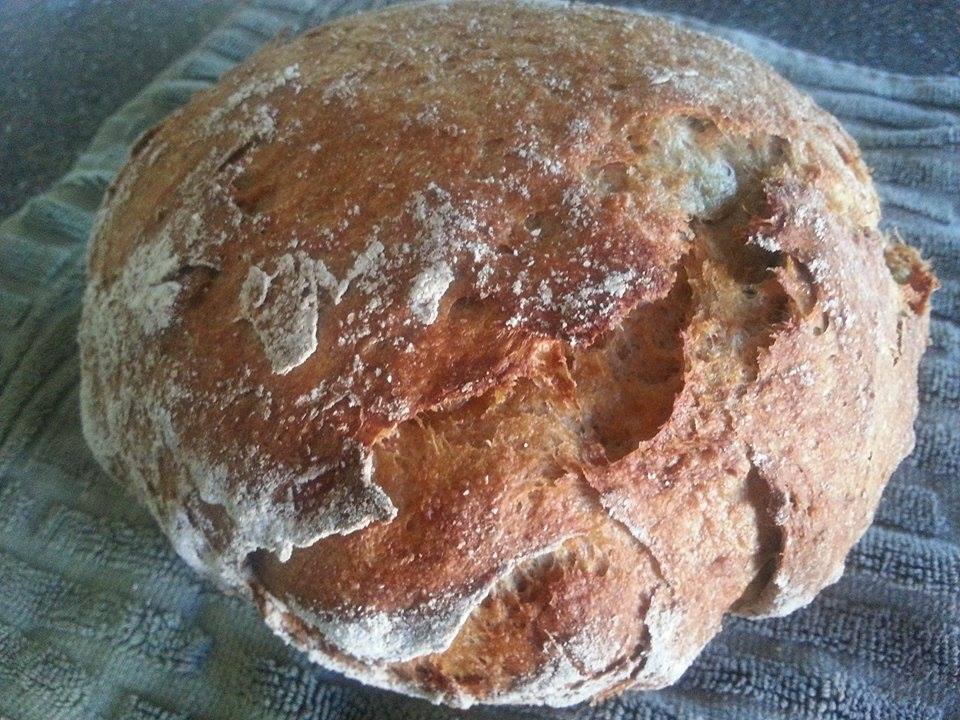
 This slow rise einkorn bread is really quite a treat. Is there anything quite like an artisan bread that has slowly developed flavors, with a hard crust and chewy middle? No, no there really isn’t. The key to the beautiful crust is a dutch oven. The heavy pot with the tight lid that seals on top simulates a professional bread oven circulating the stem back upon itself. It’s as close as we will get to the real thing here at home.1. Proof 1/2 tsp of yeast in the warm water. I tend to go a little on the hotter side, as long as you don’t go over 110 degrees you are ok.2. Sift 5 Cups of Einkorn flour, 1/2 tsp sea salt, and 1/3 c powdered milk together.3. Add the water/yeast mixture into your dry ingredients and mix with a spatula. The dough will be fairly sticky.4. Scrape the sides of your bowl down to incorporate then cover with plastic wrap.5. Let it rise for 14 hours in a dark place. The slow rise develops volume and flavor at the same time.6. After 14 hours preheat your oven to 500 with the dutch oven AND lid in the middle of your oven. This dutch oven is the key to the artisan type of bread.7. Turn your dough out onto a floured surface. Don’t work the dough too much. I fold each side of the dough inward like an envelope to create some more pockets of air.8. Once your oven is preheated, place your loaf into the dutch oven, place the lid on it and close your oven. Do this as quick as possible so you do not lose your heat.9. Bake for 35 minutes, take the lid off and bake for another 5-10 minutes.10. Cool on a rack until completely cool.11. Enjoy!(For a more detailed version of this recipe go, HERE)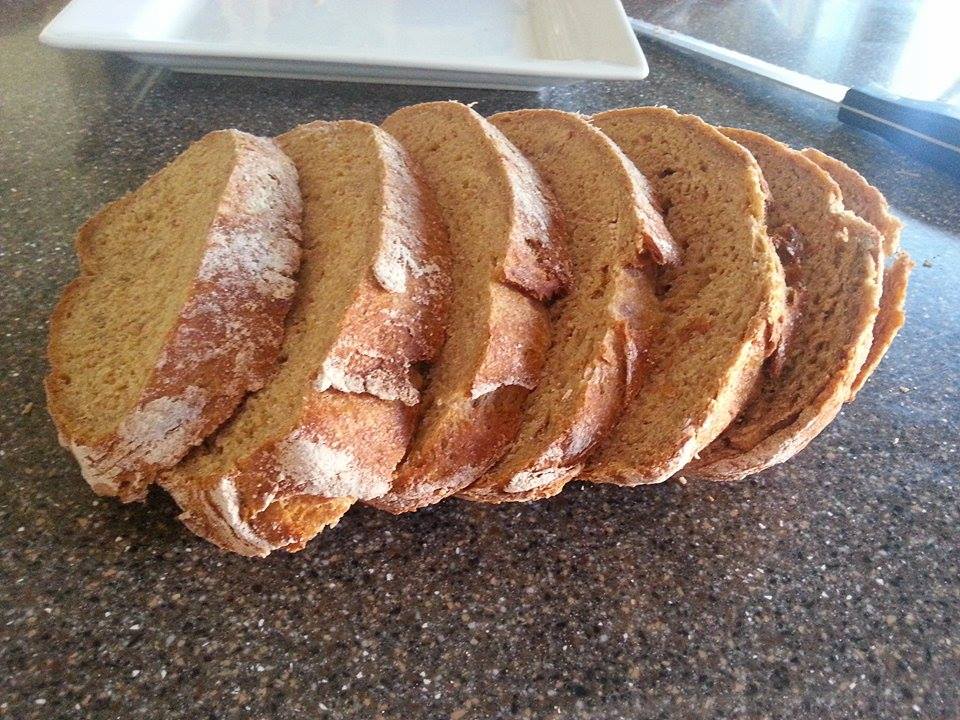
 Enjoy making this VERY simple beautiful Einkorn Rustic slow rise no worry bread.
Go here, for a deeper explanation on this recipe.
1. Proof your yeast in the warm water.
2. Sift flour, salt, and powdered milk together.
3. Add the water to your dry ingredients and mix with a spatula. The dough will be fairly sticky.
4. Scrape the sides of your bowl down to incorporate then coverwith plastic wrap.
5. Let it rise for 14 hours in a dark place. The slow rise develops volume and flavor at the same time.
6. After 14 hours preheat your oven to 500 with the dutch oven AND lid in the middle of your oven.
7. Turn your dough out onto a floured surface. Don't work the dough too much. I fold each side of the dough inward like an envelope to create some more pockets of air.
8. Once your oven is preheated, place your loaf into the dutch oven, place the lid on it and close your oven. Do this as quick as possible so you do not lose your heat.
9. Bake for 35 minutes, take the lid off and bake for another 5-10 minutes.
10. Cool on a rack until completely cool.
11. Enjoy!
Enjoy making this VERY simple beautiful Einkorn Rustic slow rise no worry bread.
Go here, for a deeper explanation on this recipe.
1. Proof your yeast in the warm water.
2. Sift flour, salt, and powdered milk together.
3. Add the water to your dry ingredients and mix with a spatula. The dough will be fairly sticky.
4. Scrape the sides of your bowl down to incorporate then coverwith plastic wrap.
5. Let it rise for 14 hours in a dark place. The slow rise develops volume and flavor at the same time.
6. After 14 hours preheat your oven to 500 with the dutch oven AND lid in the middle of your oven.
7. Turn your dough out onto a floured surface. Don't work the dough too much. I fold each side of the dough inward like an envelope to create some more pockets of air.
8. Once your oven is preheated, place your loaf into the dutch oven, place the lid on it and close your oven. Do this as quick as possible so you do not lose your heat.
9. Bake for 35 minutes, take the lid off and bake for another 5-10 minutes.
10. Cool on a rack until completely cool.
11. Enjoy! 


51 thoughts on “Einkorn Artisan Slow Rise No Worry Bread”
Ant easy recipe to use it for tortillas ( then i can use it as a burrito ,or wrap
I just made this bread today and am not sure if I’m completely satisfied with the result. The bread came out rather dense. Do you have any tip as to how to make more airy and lighter bread? I let my dough rise for 15 hours. I wonder if I should have let it rise longer and in a warmer place?
Hi Eiko, I am sorry that the recipe didn’t quite do it for you. This recipe was created by a woman who worked for einkorn.com a long time ago but she hasn’t worked here for some time. Since I am not the creator of the recipe, I have a hard time saying how to change it to make it lighter, but I do know that customers have had success with it, so I wouldn’t give up all together. Frequently, artisan breads tend to be a little denser than sandwich breads, but maybe yours was even denser than that, I don’t know. If you’re looking for a sandwich bread type of recipe you can look at our sourdough or yeast bread recipes. If you’re wanting to keep trying with the artisan bread, I would suggest letting the dough be a little wetter. Einkorn tends to be sticky so we run the risk of adding too much flour to combat that. Too much flour will lead to very dense bread. I hope that helps.
Our oven only goes reliably to 450. Will extending the cooking time a bit work?
Alan, we have not tried that. It would probably work just fine. The crust may turn out slightly different but most likely not drastically. If you try it, let us know how it turns out in case anyone else has a similar question.
Do you have sourdough recipes?
We do have a few sourdough recipes. We have muffins, bread, and crackers.The bread recipe can be used for more things like bread sticks, pizza dough, pitas, flat bread etc.
Any tips on how to adapt this recipe using an einkorn sourdough starter would be appreciated!
Jim, I have not done this recipe with a sourdough start, but, if I were going to try it, I would omit the yeast, reduce the water to 1 1/2 cups, and use about 1/2 cup of sourdough start. I would also allow the dough to double in size in a bowl and then punch it down and create the loaf and let it rise again. You may have to do a little experimenting but those are the general guidelines I would suggest.
Can I bake this in a calphalon soup pot I have that is non-stick?
I don’t used powder milk etc, can I use regular milk, or sour cream, more flour, Or What?
Thanks..
Cal, only a cast iron or ceramic pot with a ceramic lid work. They are the only kinds that disperse the heat properly. Otherwise you will need to just do the whole steam thing we talked about with the previous comment from February 5th. Powdered milk just softens the bread. You can just leave it out. If you add milk, it will throw off the moisture in the bread and make it too wet.
Do you grease the Dutch oven before putting in the einkorn bread dough? Thank you. I am anxious to try the recipe.
Yes, good point. you should grease it.
When? Before you put the pot and lid in the screaming hot oven or after?
Hi Lauri, I’d do it after.
Just put the dough on a large piece of parchment paper and lower it into the Dutch oven and put the lid on. The dough won’t stick and it is much easier to pull out the finished bread.
I had read that parchment paper works well. Will it withstand the high heat.
Just my $.02 worth: I don’t like burning greasy substances to my beautiful Le Creuset Dutch ovens! I just breaks my heart! So, instead, I take a piece of parchment paper large enough to wrap around the loaf and up the sides of the Dutch oven. Wad up and un-wad the parchment paper several times (like 3) and it will be much more malleable and shape-able and you will be able to drop the raw loaf sitting on the crinkled up parchment paper into the Dutch oven without branding your hands on the super hot Dutch oven — don’t ask me how I know this. The bread never sticks to the Dutch oven, the Dutch oven stays clean, and the parchment makes a nice sling you can use to withdraw your bread from the Dutch oven — again — without branding your hands. Parchment is yet another thing you’d have to buy, yes, but the results are excellent!
Can you bake this bread recipe in a roasting pan? Or other ideas? I don’t have a dutch oven yet.
Katie, I was wondering the exact same thing. Wondered if I could use a roasting pan with foil sealing in the top.
Katie and Kelly, The purpose of the dutch oven is to create steam inside the pot, rising the loaf and creating a hard crust on the outside. If you don’t desire that, you can just cook it on a cookie sheet. If you do want it, you can put it on a cookie sheet and then put another cookie sheet on the rack beneath it. But you have to put it in the cold oven on the bottom rack and preheat the pan while the oven preheats. Then, put the loaf in the oven on a cookie sheet on the middle rack and pour boiling water in the bottom pan and quickly shut the oven. This will create the steam.