

For over 7,000 years, mankind has cultivated and developed wheat for breads and cereals. Today, we consume more wheat, as a percentage of our daily diet, than any other food. Just think about that and the effects wheat can have on our health – good or bad!
I’ve been researching the nutritional content of 19 different types of wheat, and I’ve included a link to all of my findings in this post. This post focuses on the nutritional content and health benefits of einkorn wheat compared with the common types of wheat of which most of our food from the grocery store is made.
In doing my research, it is easy to see why there has been renewed worldwide interest in ancient einkorn. The interest comes not only from einkorn’s unique gluten structure but also it’s incredible nutritional qualities.
Here are some interesting facts I learned about the nutritional content and health benefits of einkorn:
- Wheat gluten studies have found einkorn may be non-toxic to suffers of gluten intolerance
- Einkorn wheat has 14 chromosomes while modern wheats have 42 (Friendly to the body’s digestive system)
- Einkorn contains 3 to 4 times more beta-carotene than modern wheats (Boosts immunity, helps prevent cancer and heart disease)
- Einkorn contains 2 times more Vitamin A (retinol equivalent) than modern wheats (Healthy eyes, reproductive organs and prevention of many cancers)
- Einkorn contains 3 to 4 times more lutein than modern wheats (Prevention of macular degeneration and cataracts)
- Einkorn contains 4-5 times more riboflavin than modern wheats (Used by the body to create energy and is an antioxidant that slows aging)
- Einkorn is a “hulled” wheat, whereas modern wheats are not. The hull can protect the grain from stray chemical contamination and insects making it an easier grain to grow ORGANICALLY!
Einkorn vs Major Types of Wheat Comparison Matrix
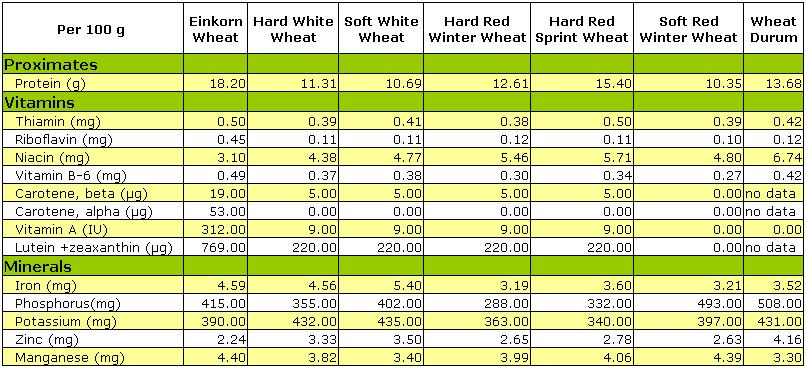
See my full nutritional matrix comparing 19 types of wheat (pdf), including einkorn. This matrix also includes my sources and references.

53 thoughts on “Types of Wheat: Nutritional Content & Health Benefits Comparison”
Do you know if any of the wheat in your comparison chart was non-GMO? The reason I say that is because the GMO wheat has been modified so that when it rains, it still stands up straight, and the water gets into the wheat and creates mold. The purpose for this modification was so that combines could get in and harvest the wheat easier. Whereas the non-GMO wheat lays over when it rains and the water runs off. The plant and does not have any mold that forms in it then. I feel like many of the wheat allergies are actually mold allergies. I assume because the einkorn wheat is tight , the water can’t get in there and allow the mold to form.
Hi Lisa, I haven’t done research about this specific thing, but just to clarify, there is no commercial GMO wheat sold in the US right now so GMO is not really the question. Maybe you are talking about hybridization? Modern wheat has been hybridized to have certain characteristics. I haven’t heard of this specific issue, but none of these grains are GMO. Some of them may have been hybridized for easier threshing in this way, but I don’t know. I imagine hull in spelt, emmer, and einkorn would help but we haven’t researched this issue.